
vffs film tracking problem is the first checkpoint buyers should lock before they approve a supplier, budget, or production slot. You’re running a tea packing shift, and the film starts walking left. The forming tube looks straight, the pull belts feel tight, but the drift keeps coming. Here’s what most plant floors miss: a VFFS film tracking problem rarely starts at the tube. 70% of these faults trace straight back to the unwind roll tension and the dancer arm — not the metal collar you’ve been tapping with a wrench.
A 2mm dancer arm misalignment translates to 5mm of bag length drift. That’s enough to ruin a batch’s look and flatten your OEE score. Re-wound scrap rolls make it worse — irregular winding tension triples the tracking variance, pushing your scrap rate up by 15%. Spend 10% more on tension-controlled mill rolls with COF below 0.3, and the math flips. Waste drops by 30%.
Static discharge from film accumulation can mimic a mechanical drift fault. No one talks about this. If the drift shows up after a splice or during a long run in dry air, ground the dancer assembly and check ambient humidity. Temperature shifts also change the damping oil viscosity in the dancer arm, creating sporadic shifts that vanish before the next shift logs them. The fix isn’t a service call; it’s specifying an oil grade that holds steady across 24/7 production. The following sections lay out the exact symptom-to-cause map, torque sequences for lock-collar parallelism, and sensor calibrations that get the line back on center without guesswork.
Common Tracking Symptoms & Causes
70% of tracking faults originate at the unwind roll—not the forming tube.
When film walks off-center or bag length jumps, operators instinctively adjust the forming tube. That’s a mistake. The root cause is usually upstream in the web path—tension, alignment, or film quality. Below is a mapping of each symptom directly to its most likely mechanical trigger and the exact adjustment to stop it. No theory, no fluff.
- Symptom: Film drifting left: Excessive tension on the left film edge typically comes from an unwind spindle that isn’t parallel to the forming tube. Check the lock-collar tightening sequence—use a cross-pattern torque to 5 Nm on the side guide roller lock screws. Even a 1mm spindle skew translates into steady leftward pull. Also confirm the unwind brake torque is symmetric within 0.8–2.5 N; a lopsided reading signals an unevenly worn brake pad.
- Symptom: Film drifting right: Same root cause, opposite direction. Right-side drift means the right film edge is tighter, usually because the unwind spindle is tilted toward the right. Repeat the cross-pattern torque sequence and verify that film roll edge deviation is under 3mm and telescoping is under 2mm. Re-wound film rolls introduce irregular winding tension that can increase tracking variance by 3x—if you’re running scrap-grade film, right-side drift can appear randomly right after a splice.
- Symptom: Random bag length changes: A dancer arm misalignment is the hidden trigger. A 2mm skew at the pivot can cause up to 5mm of bag length drift. Check dancer arm parallelism monthly with a spirit level. Bearings with play exceeding 0.1mm must be replaced on sight. Pull belt residue and dust alone cause 20% of registration drift incidents; wipe down pull belts and clean the photo-eye lens before chasing the encoder or servo drive.
- Symptom: Post-forming wrinkles: Wrinkles after the forming tube often mimic tracking faults but are actually static or tension-driven. ESD from film accumulation can make film stick to rollers, pulling it off-center—ground the dancer arm assembly and keep ambient humidity above 40% RH. In long production runs, temperature-induced viscosity shifts in the dancer arm damping oil cause sporadic tracking drift; specify an ISO VG 32–46 damping oil rated for 24/7 ambient stability. Also confirm the forming tube shoulder radius matches the film width; a mismatch creates symmetrical wrinkles that operators frequently misread as tracking error.
- Monthly: Dancer arm parallelism: Place a precision spirit level across the pivot axis. Replace bearings immediately if radial play exceeds 0.1mm.
- Monthly: Lock screw torque verification: Re-torque side guide roller lock screws to 5 Nm using the cross-pattern sequence to avoid micro-skew.
- Start of each shift: Unwind brake check: Dial in brake torque between 0.8 N and 2.5 N. Increase gradually until film flutter just stops. An asymmetric feel means brake pad replacement.
- Every film roll change: Roll geometry inspection: Edge deviation must stay below 3mm, telescoping under 2mm per side. Reject re-wound rolls with visible layer-to-layer offset.
- Weekly: Pull belt and photo-eye cleaning: Remove dust and product residue from pull belts. Wipe photo-eye lens with lint-free cloth and recalibrate contrast if needed.
- Monthly: ESD grounding verification: Check continuity between dancer arm frame and machine ground. Maintain facility humidity above 40% to suppress static buildup on film.
- Quarterly: Damping oil inspection: Replace dancer arm damping oil if it shows viscosity drift. Use only ISO VG 32–46 oil rated for ambient temperature range of your plant.
Dancer Arm & Roller Alignment
A 2 mm dancer arm skew translates into a 5 mm bag length drift—level it first.
Grab a 300 mm precision spirit level and place it across the dancer arm pivot shaft. The bubble must center exactly when the arm is at rest and the film is static. Even a half-degree tilt rewrites the tension balance left to right. If the level shows a bias, loosen the four spindle lock-collar bolts and re-tighten them in a cross-pattern sequence at 12 N·m. Tightening them one-by-one introduces micro-skew—the single biggest reason alignments drift again within a shift. After torquing, re-check the level and rotate the shaft by hand to confirm it spins without binding.
Bearings wear silently until the film tells you. Push the dancer arm sideways with 20–30 N of radial force. If you feel lateral movement or hear a dry click, measure the play with a dial indicator. The limit is 0.1 mm. Anything beyond that causes intermittent lateral film oscillations that look identical to a photo-eye fault—operators waste hours recalibrating sensors while the real problem sits in the pivot. Replace the bearing pair as a set, not individually, and use sealed deep-groove bearings rated for 6,000-hour minimum L10 life at full line speed.
- Side guide roller contact: Position each roller so it just kisses the film edge without compressing the web. Run a 50 mm strip of paper between the roller and the film; it should slide through with light drag. Then lock the roller set screw to 5 N·m. Over-torquing deforms the roller axle slightly, creating a tight spot that grabs the film sporadically and mimics static cling fault.
- Unwind brake calibration: Start at 0.8 N brake torque. Run the machine at jog speed and watch the dancer arm movement. Increase the brake in 0.3 N increments until the film runs flat without fluttering. The final value typically lands between 1.2 and 1.8 N for 60-micron laminated film. If you exceed 2.5 N to stop flutter, the film roll has excessive telescoping or edge deviation—mark the roll for QC rejection.
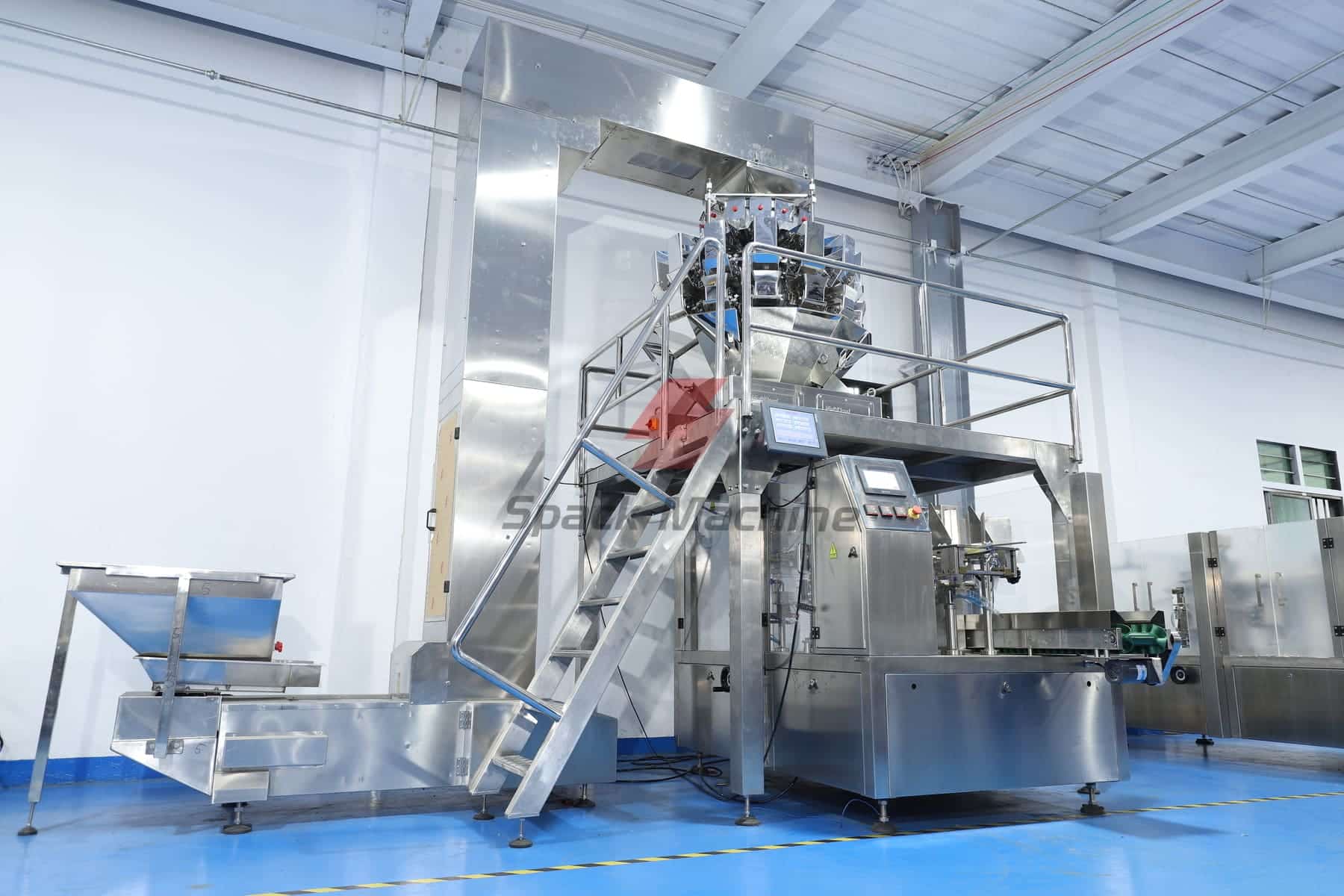
If the line runs 24/7, add two items to the monthly dancer arm PM card. First, ground the dancer frame with a copper braid strap to the machine earth—static discharge across accumulating film can produce enough cling force to steer the web 2–3 mm off center, and it will vanish the minute you touch a meter. Second, check the damping oil temperature after a 10-hour run. Viscosity thinning from retained heat reduces dampening response and creates slow drift. SpackMachine specifies ISO VG 32 hydraulic oil for ambient stability between 18 °C and 38 °C; anything lighter turns the dancer into an undamped spring.
Film Quality Specs & Roll Inspection
Re-wound scrap film triples tracking variance—inspect every incoming roll.
On high-speed VFFS lines, film roll quality isn’t a nice-to-have—it’s the first gatekeeper of bag accuracy. A roll with a 2mm telescoping defect or a COF shift of 0.1 can produce random drift that looks exactly like a mechanical fault. Before you touch a single dancer arm bolt, measure what you’re loading onto the unwind spindle.
- Roll edge deviation < 3mm: When the film edge wobbles more than 3mm side-to-side, the dancer arm chases a moving reference line. You’ll see intermittent left/right drift and bag width variation. Check with a dial indicator on the unwind shaft boss, not by eyeball.
- Telescoping < 2mm per side: A telescoped roll (layers shifted axially) creates uneven unwind tension as the diameter changes. This is the #1 cause of bag length creep after a roll splice. Measure at four points around the roll; reject if any side exceeds 2mm.
- Core ID tolerance ±1mm: An oversized core slips under the expansion chuck, introducing micro-jerk that confuses the registration photo-eye. An undersized core jams the chuck and can score the spindle. Verify with a go/no-go gauge before every shift.
- Coefficient of friction (COF) < 0.3: Film-on-steel COF above 0.3 causes pull-belt slippage and registration drift, especially in humid environments. Request supplier COF test data and aim for 0.2–0.25 for optimal tracking. Static dissipative coatings help, but they must be applied by the mill—not a converter.
- Young’s modulus consistency: Stiffer film (high modulus) resists the forming collar, requiring higher unwind brake torque. If your supplier changes resin grade without notice, you’ll see post-splice bag length shifts because the film stretch rate changes. Specify modulus tolerance ±5% on your purchase order.
Tension-controlled winding from the mill is non-negotiable for lines running above 40 bags per minute. Re-wound rolls—whether from a slitter, a converter, or your own scrap recovery—carry irregular tension bands that increase tracking variance by 3x. The cost of that re-wound roll almost always lands in your scrap bin. Spend the extra 10% on mill-wound, certified rolls that arrive with edge profile reports. Your servo-driven unwind system can compensate for minor winding flaws, but it can’t unscramble a roll that was wound with zero tension regulation. And if you see a ‘bargain’ roll that shimmers when unwinding, you’ve already lost money.

Photo-Eye Calibration & Belt Maintenance
20% of bag-length drift incidents trace back to pull belt residue — not the forming tube.
When the photo-eye lens accumulates film dust, static-charged particles, or oil mist, the sensor starts missing registration marks or false-triggering on print artifacts. The result is random bag-length variation that gets mistaken for a mechanical tracking fault. Before you touch a single lock collar, clean the lens with a lint-free wipe and a mild optical cleaner. If the lens is scratched, replace it — micro-abrasions scatter the beam and degrade contrast detection on low-COF films.
- Lens cleaning frequency: Every shift if running printed film; minimum weekly for clear film. Wipe dry after cleaning. Do not use compressed air — it forces debris into the sensor housing.
- ESD interference: Static accumulation on the film web can discharge near the photo-eye, producing ghost signals. Ground all dancer rollers and maintain ambient humidity above 40% RH. In dry environments, an anti-static cord mounted 50 mm ahead of the sensor eliminates this variable.
- Teach-mode recalibration: After cleaning, run the ‘teach’ function with the actual production film. Block the sensor path with the printed mark, then with the background. If the contrast delta is below 15%, the sensor gain needs manual adjustment — auto-teach often fails on metallized or semi-transparent laminates.
Pull belts that look clean to the naked eye carry a micro-film of polyethylene wax and dust. This coating reduces the coefficient of friction between the belt and the film to below 0.2, which is enough to cause inconsistent advance even when the servo motor runs perfectly. Wipe the belts with isopropyl alcohol on a cotton rag at every product changeover. If the belt surface feels glossy or slick, the contamination has already embedded into the rubber pores — replace the belts. This single wipe-down routine eliminates the 20% of bag-length drift that is purely slip-induced, not electronic.
After cleaning, run 50 bags at steady speed and measure the length across 10 consecutive samples. If the CV (coefficient of variation) is still above 0.8%, check the belt tension. On most VFFS machines, a 2 mm deflection under 10 N of thumb pressure at the belt midpoint indicates correct tension. Loose belts amplify the slip effect and create the same random drift pattern that gets wrongly attributed to the encoder.
Conclusion
Applying the tracking corrections outlined here eliminates the root causes of most film drift: unwind tension imbalance, dancer arm misalignment, and contamination on belts or sensors. You reduce unplanned downtime, scrap, and that creeping bag-length drift that erodes customer confidence. Monthly parallelism checks and roll quality inspections keep OEE high and maintenance costs per thousand bags low.
When film tracking failures become a weekly frustration, it’s time to look at a machine built for precision web control. SpackMachine VFFS machines feature rigid frames and accessible dancer arms engineered to stay aligned shift after shift. Visit the product page for full technical specs and a demo request.
Frequently Asked Questions
Why does my VFFS bag length change after a film roll splice?
A splice disrupts unwind tension because the new roll often has different winding tightness or diameter, making pull belts feed inconsistently. Check the dancer arm response immediately after splicing. Recalibrate the unwind brake after every splice to lock in consistent length.
Can I run different film widths on the same forming tube?
No, a forming tube is sized for a specific film width and bag circumference; running a different width causes tracking drift and seal misalignment. Use the correct tube for the film. Keep dedicated forming tubes per film width to prevent off-center drift.
How often should I clean the dancer arm pivots?
Clean them monthly, or immediately if film starts fluttering, because dust buildup creates friction that can skew the dancer arm by even 2mm, causing 5mm of bag length drift. Schedule monthly pivot cleanings to prevent hidden skew.
Why won’t my film track properly on the VFFS?
Tracking fails most often from uneven unwind tension or a misaligned dancer arm—not a bent forming tube. Check spindle alignment and dancer level before adjusting pull belts. Start at the unwind roll—it’s the hidden source of most tracking drift.
How do you fix film that runs off-center?
Level the dancer arm first, then center the film spindle and set side guide rollers to just touch the film edge without binding. Fine-tune the unwind brake for smooth. Level the dancer arm first—it corrects the root cause, not just the symptom.