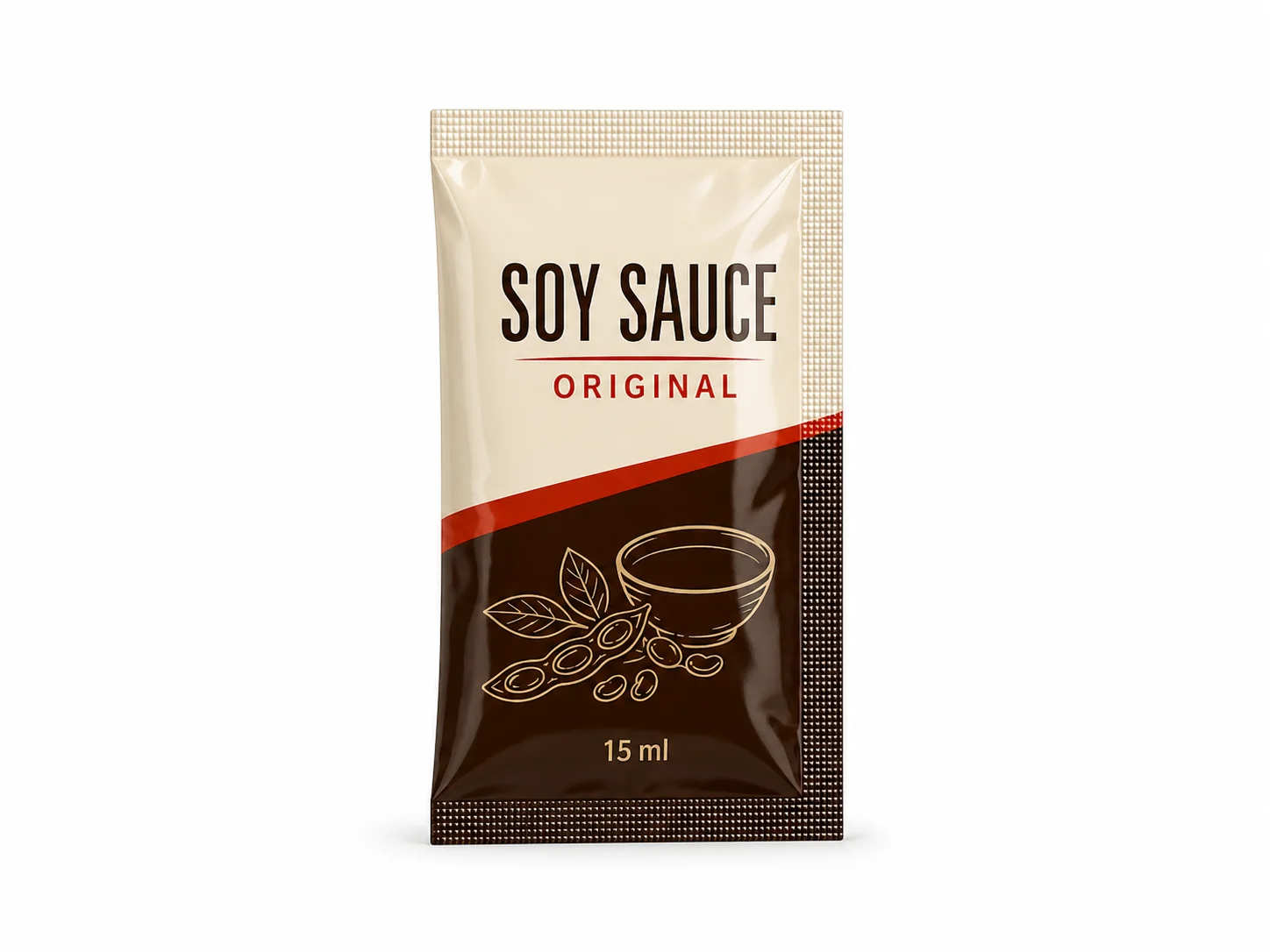
3-side-seal sachet
A flat pack with one folded edge and three sealed edges. Mark the fold, seal bands and tear position on your drawing before selecting the forming arrangement.
3-side format page — review the seal layout.

Sachet packaging routes
Choose by bag format, product and dose. Then match the filling system and output.
A sachet packaging machine, also called a sachet packing machine or sachet filling and sealing machine, can form small packs from roll film, dose the product, then seal and cut each pack. Compare 3-side and 4-side sachets, stick packs, pillow packs and shaped sachets below. Start with your finished bag and product sample to shortlist a VFFS configuration.
Buying premade pouches? Compare a rotary or horizontal premade machine. Filter tea bags and drip-coffee bags require a separate machine selection.
3-side sachet
 4-side sachet
 Stick pack
 Pillow pack
 Shaped sachet
Illustrations of finished bag formats. Confirm the design and film for your product.
01
Finished bags
Start with the seal layout and finished dimensions. These five formats require different forming or sealing arrangements. A bag drawing helps identify which configuration to review.
A flat pack with one folded edge and three sealed edges. Mark the fold, seal bands and tear position on your drawing before selecting the forming arrangement.
3-side format page — review the seal layout.
A flat pack sealed on all four edges. Confirm the seal bands, usable filling area and film arrangement; the tooling differs from a folded 3-side sachet.
4-side format page — review the seal layout.
A narrow pack with a longitudinal back seal and top and bottom cross seals. Confirm the stick width, length and opening feature; these determine a different forming arrangement from a flat sachet.
Or screen the host on the VFFS pouch section.
A pack with a rear longitudinal seal and top and bottom cross seals. Specify the finished width, length and back-seal layout when requesting a small pillow-pack configuration.
A sachet with a contoured outline. Send the final shape, cut line, opening feature and artwork registration for a tooling review.
Format references. The five images illustrate bag formats; they are not customer production samples. Connected sachets or strips add cutting and counting requirements that should be specified separately.
02
Sachet vs stick
Flat sachets and stick packs use different seal layouts. Use the drawing and opening requirements to choose a route before comparing machine configurations.
| Decision point | Flat sachet | Stick pack | Next page |
|---|---|---|---|
| Form | Flat, compact pack | Narrow, elongated pack | Flat sachets: compare the VFFS page. Stick: stick pack page. |
| Seal layout | 3-side or 4-side seal | Longitudinal back seal plus top and bottom cross seals | |
| What to send | Finished drawing, which edges seal, dose, film and registration | Stick width and length, back-seal layout, dose, film and tear feature | |
| Do not call it | A stick pack, or a premade zipper pouch | A 3-side or 4-side flat sachet |
Need a fuller comparison? Explore definitions, uses and design differences in the sachet definition page and the sachet vs stick guide before finalizing your pack design.
03
How it works
Roll-film sachet packaging combines four main tasks. Their timing and equipment depend on the bag format, filling system and agreed configuration.

Stage 1
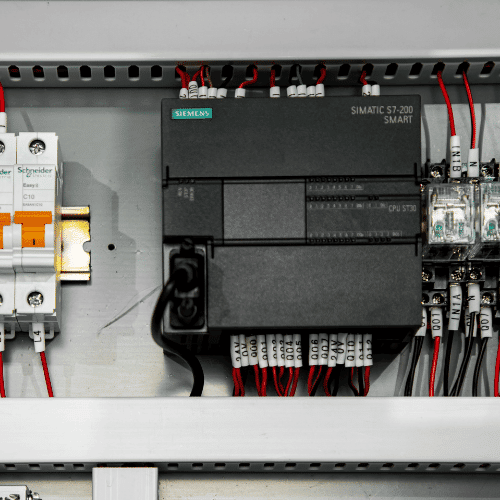
Rollstock is fed into the film path. If the web is printed, a photoelectric eye reads the registration mark. Finished bag width and film roll width are different numbers — send both.
Stage 2
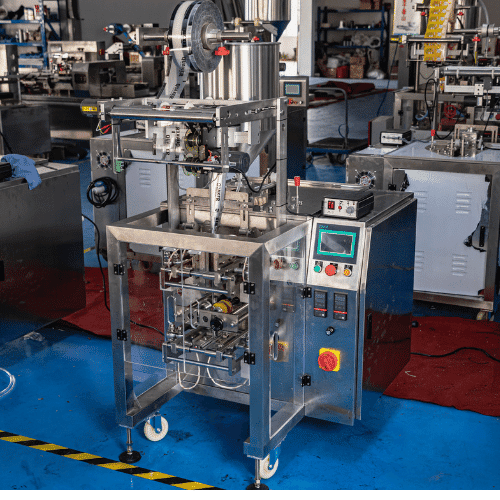
The web is formed to the bag geometry: a tube for pillow and stick, or a flat 3-side / 4-side layout. These do not share one former. Shaped cuts add their own tooling review.
Stage 3
Powder, granules, liquids and small solids use different filling routes. Dust on the seal, bridging, viscosity and piece count decide the filler — not the word “sachet”.
Stage 4
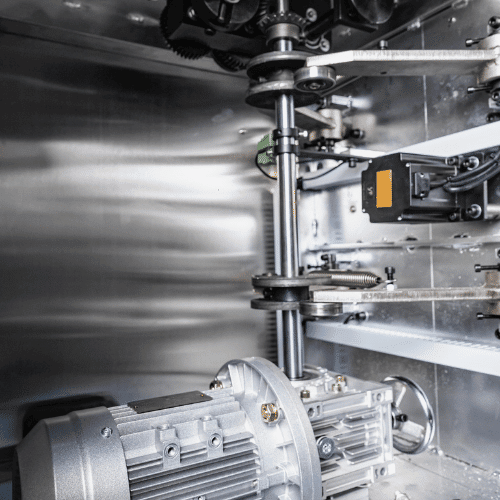
Sealing and cutting complete the pack before discharge. Specify coding, inspection and secondary packing separately; the location and timing of each station depend on the line.
Photo scope. The four photographs show VFFS-family equipment for reference. Confirm the supplied machine, film path and filling system against your project configuration.
The bag is created on the line from a reel: formed, filled and cut at serving size. Start with the finished bag and film specification.
Film structure, roll width, core, outer diameter, unwind direction and the eye-mark still have to be confirmed with the finished-bag drawing. They are not the same input.
The pouch arrives already made. The machine handles, opens, fills and seals it. Compare bag supply, size changes and line requirements before choosing between premade pouches and roll film.
If you buy zipper, stand-up or other premade pouches, you are on the rotary or horizontal premade family — not a sachet VFFS host.
04
Product and dosing
Start with product behaviour, target dose and the required tolerance. Powder flow, particle size, viscosity and cleaning needs help determine the filling route.

Review an auger for cohesive powders and an electronic-scale route for free-flowing powders, then confirm the choice with a representative sample. Review flow, bulk-density changes, bridging and dust near the seal using a representative sample. See powder packaging.
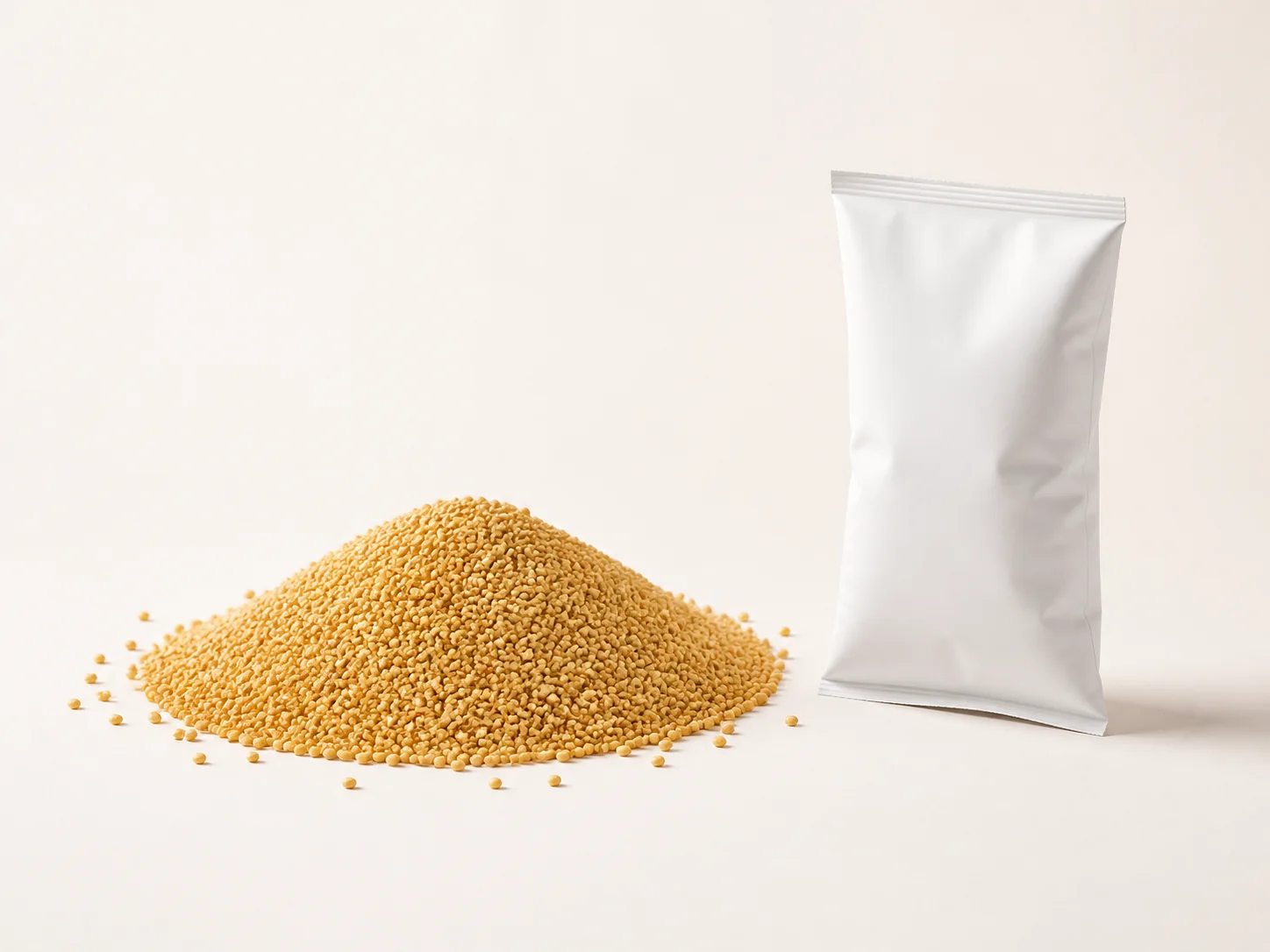
A volumetric cup meters volume; a weigher meters mass. Compare product flow, bulk-density stability, piece size, fragility and target dose. Piece counting needs a separate assessment. See granule and solid packaging.

A matched pump or piston can be considered for liquids and pastes. Specify viscosity, temperature, particles, foaming, dripping and cleaning requirements for review. See liquid and paste packaging.

Share piece dimensions, fragility and whether the dose is by weight or count. Feeding, passage through the filling area and clearance from the seal need to be checked together.
Screening images. These images illustrate product types. Confirm dosing and sealing with a representative product sample and the intended film.
05
Machine options
Use finished pouch width to begin comparing VFFS-220 / 320 / 420. If your brief calls for a high-speed pouch line, review the second family as well. Confirm the bag format, filling system and sustained output for either route.
VFFS-220 / 320 / 420
A roll-film machine family to review for sachets, stick packs and pillow bags. Start with finished pouch width, then confirm the bag format, forming set, filler and film together.
What the machine has to do
Unwind and register the web, form the chosen bag, receive the dose, seal and cut. Premade zipper pouches are out of scope on this host.
Selection checks
VFFS 320S / 420S / 620S
Review this VFFS family when comparing a high-speed pouch project. Send the finished bag, dose and target output so the proposed configuration can be checked against your requirements.
What the machine has to do
Form, fill, seal and discharge the selected pack. Confirm sachet-scale dimensions and the dosing arrangement; the family name alone does not establish suitability.
Selection checks
Screening figures. The VFFS-220 / 320 / 420 width limits shown above are published screening references. They do not confirm every seal style or film at that width. Ask for a configuration sheet, bag drawing and sample-run results that match your product, dose and film.
06
Side by side
Use this to shortlist. Then open the machine page and check the forming set against your own bag drawing.
| Finished bag | Open first | Fits when | Does not fit when |
|---|---|---|---|
| 3-side or 4-side sachet | VFFS-220 / 320 / 420 | You sell a flat single-dose pack formed from rollstock, and you can send a drawing that shows which edges seal. | The pouch is already made, or you need a zipper / stand-up premade pouch. |
| Stick pack | Stick page, then VFFS pouch section | The pack is narrow, with a back seal and two cross seals, and the dose is a single serve. | You are describing a flat 3-side or 4-side sachet with a different name. |
| Pillow / back-seal | VFFS pouch section | The pack has a rear vertical seal. Screen width on 220 / 320 / 420 (100 / 150 / 200 mm published maxima). | The bag is premade, or its width falls outside the published screening range and needs a separate assessment. |
| Shaped sachet | VFFS pouch section | You already have a contour drawing and accept a tooling review. | The outline, seal area or registration requirements have not yet been defined. |
| High-speed pouch requirement | High-speed VFFS page | You have defined the bag, dose and sustained output to assess against a proposed configuration. | You are assuming that “high-speed” confirms a multi-lane layout or a guaranteed rate. |
| Premade small pouch | Rotary or horizontal premade | The bag arrives finished. The machine opens, fills and seals it. | You are buying roll film and need the machine to form the sachet. |
Using the published width limits. Published maxima are 100 mm, 150 mm and 200 mm on VFFS-220 / 320 / 420. Compare quotations on bags per shift, on the same bag, not on a peak figure copied from another page.
07
Output scale
“Small” or “mini” may describe the pack, footprint or budget. Specify these separately from the number of lanes and the good sachets required per shift.
A single-lane arrangement produces one pack across each bag-making cycle. For a first automatic line, define the target dose, usable shift time and format changes. Check whether the proposed setup can meet that schedule with your product and film.
A multi-lane arrangement forms several packs side by side. Confirm lane count, dosing per lane, film width, change parts and discharge or counting requirements. Compare good sachets per shift, not just cycles per minute.
Use the same bag, product, dose and shift schedule in every quotation. Include feeding, changeover, cleaning and secondary packing when comparing footprint and cost. For investment questions, see the small-sachet guide.
Automatic lines. The machine pages above are starting points for an automatic VFFS review. Lane count is confirmed for the proposed configuration; it cannot be inferred from “small”, “mini” or “high-speed”. Include any multi-lane requirement in your enquiry.
08
Project inputs
Send the information you have for these eight inputs. Mark anything still undecided so it can be resolved during the configuration review.
Sample validation. Compatibility is confirmed with a production-representative product sample and your intended film. A product name or a photograph alone does not confirm dosing or sealing.
09
Before you order
For an imported line, confirm site utilities, documentation and acceptance conditions before ordering. The checklist below also helps compare installation requirements across suppliers.
Confirm supply voltage, phase and frequency against the configuration, along with compressed air. Request the electrical and air requirements for the proposed configuration, and check them against the actual factory supply.
Share the operating temperature and humidity range. Moisture-sensitive products and films may need additional checks for stable output in humid conditions.
Decide which certificates and food-contact declarations you need on arrival, and who issues them — the machine builder or the film supplier. On the machine side, VFFS-220, VFFS-320 and VFFS-420 are CE-marked under Machinery Directive 2006/42/EC (UDEM Cert. M.2024.206.C100050, valid to 2029-04-25); the certificate and declaration of conformity come with the quotation.
Ask the freight provider or customs broker to confirm transport and clearance requirements using the proposed machine and shipping documents. The customs clearance walkthrough provides questions for that discussion.
Agree what the machine has to demonstrate before it ships — which product, which film, which bag, what weight tolerance — and that it runs your sample, not a generic one.
List wear parts and the change parts for each bag size you plan to run. Ask which items are included, how additional formats will be handled, and what the quotation covers for warranty, support and replacement-part freight.
Written scope. Agree lead time, installation responsibilities and after-sales terms in the quotation. First-time importers can also use the packaging machine buying guide. Include your destination country and any local-service requirement in the enquiry.
10
Common questions
Answers to common questions about bag format, filling systems, output and project scope.
The roll-film machines covered here form a small flexible pack, dose the product, then seal and cut it.
Choose the finished bag format first, then check the forming arrangement and filler. A premade-pouch machine follows a different process because the bag is already made.
A flat sachet uses a 3-side or 4-side seal layout. A stick pack is a narrow tube with a longitudinal back seal and top and bottom cross seals.
They are both small flexible packs, but they are not the same format. The short table above is enough to choose a route; the full comparison is on the sachet vs stick guide.
Read the finished-bag drawing. A 3-side sachet has one folded edge; a 4-side sachet is sealed on every edge.
Do not pick from a photograph of someone else’s pack. Send the drawing, then open the VFFS pouch section to see both formats on the same host family.
Not on one assumed filler. The VFFS host can be discussed for powders, granules/solids and liquids/pastes, but each state needs its own dosing route after a sample.
Dust, bridging, piece size and viscosity change the filler. A product name is not a compatibility list.
These terms can describe pack size, floor space or budget. They do not specify a lane count or a verified output.
Decide the finished bag first. Cost and scale questions stay on the small-sachet guide; compare quotations using the same bag and production requirements.
Price depends on the bag format, dose, filler, lane arrangement and equipment included in the line.
Use the same finished bag, dose, film and shift target in each enquiry, and ask suppliers to itemize coding, inspection and secondary packing.
Use the good sachets required per shift as your target. Ask for a sample-run rate with the same product, dose, bag and film, plus the number of lanes and the time allowed for stops and changeovers.
Actual output depends on dose, bag length, film, sealing time, filler and product behaviour. Compare quotations on bags per shift, on the same bag.
No. Finished width and length describe the bag you sell. Roll width, repeat length and the eye-mark describe the web that makes it.
Send both so the forming arrangement and artwork can be checked together.
Paper or laminated-paper webs must be selected by their structure and sealing properties.
Send the film supplier’s data sheet and a representative sample to check whether the intended structure will form and seal on the proposed machine.
No. A sachet VFFS host forms the bag from roll film. A premade-pouch machine opens a bag that already exists and only fills and seals it.
Zipper, stand-up and other premade pouches belong on the rotary or horizontal premade pages.
Open the vertical form-fill-seal page first if you are screening a sachet-scale bag by finished width on VFFS-220, 320 or 420.
Open the high-speed pouch page when the project is already a higher-output VFFS conversation. Confirm the proposed configuration and lane arrangement before comparing output.
Confirm the machine’s origin, destination requirements, utilities, shipping scope and support arrangements in writing.
Include your country and any requirement for local installation or service. These requirements should be agreed with the proposed configuration and quotation.
Bag-in-bag is a secondary-pack question: finished sachets counted and packed into an outer bag. Confirm the counting and outer-packing equipment separately in the quotation.
If the retail unit is a bag of sachets, put the count and the outer bag in the first enquiry. It changes discharge and layout.
Inclusion depends on the quotation. Confirm each required module and its interface with the packaging machine.
Feeding, dosing, coding, checkweighing, metal detection, reject, discharge and cartoning are scoped item by item against the product and the site.
No. Pillow packs, 3-side sachets, 4-side sachets, shaped sachets and stick packs do not share one universal forming and sealing route.
List every intended format and size. Confirm the change parts, adjustment steps and changeover conditions for each one.
Yes. The VFFS-220, VFFS-320 and VFFS-420 used for sachets are CE-marked under Machinery Directive 2006/42/EC (EN ISO 12100, EN 60204-1, EN 415-1). The technical file was reviewed by UDEM, certificate M.2024.206.C100050, valid to 2029-04-25. Ask us for the certificate and declaration of conformity.
A production-representative product sample, the finished-bag drawing, the target dose and the output you need per shift.
Film data, site power and floor dimensions complete the picture. Mark any missing information for follow-up during the review.
11
Read next
Explore the guides for pack terminology, cost planning and machine-buying questions. Return to the machine options once your requirements are clearer.
Definition
The information page for sachet meaning, uses and the long-form sachet versus stick comparison.
Format
When the pack format is still a commercial question rather than a machine question.
Scale
Questions to help compare investment, production needs and available space.
Operation
Further background on the packaging process and machine selection.
Machine
Review pouch formats, the width screen and configuration questions.
First import
What to define, what to ask for, and where first-time import projects lose time.
12
Next step
Send your bag drawing, product and target dose, film information and required output. Include a lane requirement if specified so the machine and filling route can be reviewed together.
Project confirmation. Machine, forming set, filler and output are confirmed against your samples and site conditions before anything is quoted as final.