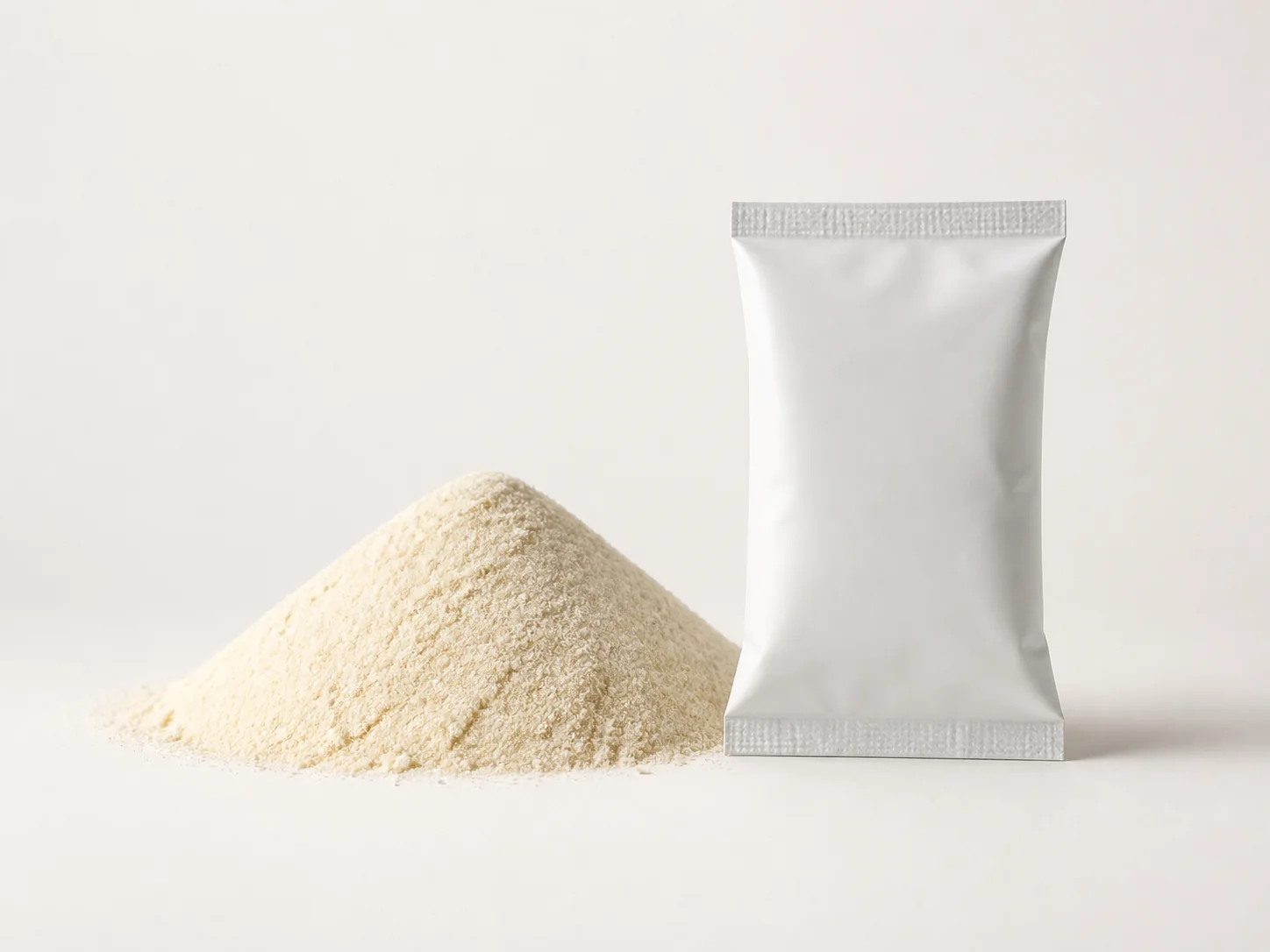
Powders
Dust on the seal is the usual failure, not brochure speed. An auger route is a common starting point. Free-flowing and cohesive powders still need a sample. Industry notes: powder packaging.

3-side sachet routes
One folded edge, three seals. Match the forming setup to your sachet.
A 3-side-seal pouch is a flat sachet with one folded edge and three sealed edges. Spack Machine offers VFFS configurations for this format. Start with your product, fill amount and finished sachet size, then confirm the film and forming setup.
4-side sachets belong on the 4-side sachet guide. Stick packs belong on the stick pack guide. Compare other sachet formats in the sachet guide. Premade zipper stand-up belongs on a rotary or horizontal premade host.
01
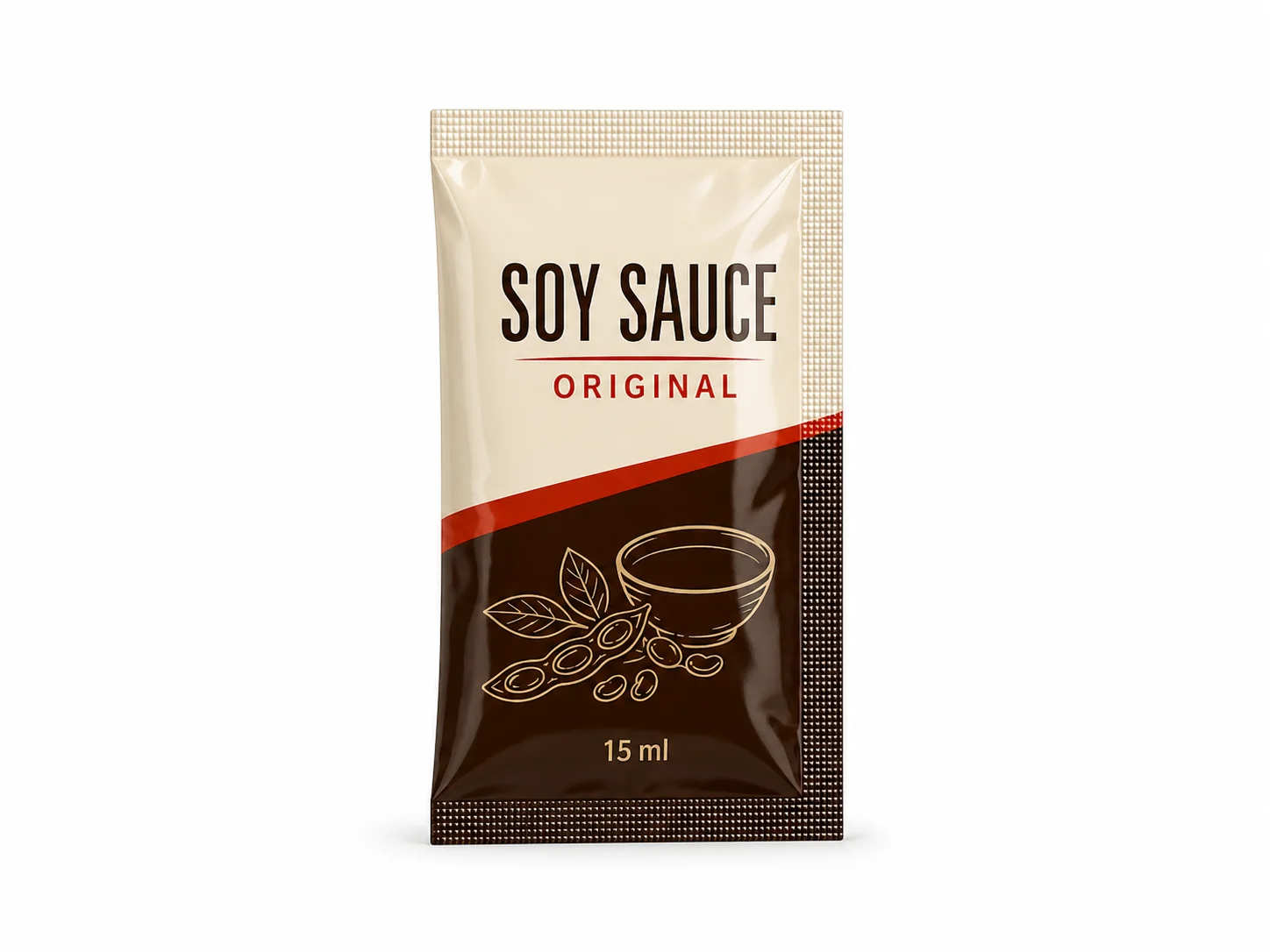
Finished pack
Three seals make the pack. One edge of the web is folded; the other three edges are sealed. It is a flat sachet, not a back-fin pillow and not a stick.
Format reference. Use the example to identify the seal layout. Your finished-bag dimensions and film specification are needed to confirm the forming and sealing setup.
02
Vs other bags
This table is only enough to stop a mis-route. The long comparison — uses, graphics, “which is better” — stays on the vs article. Do not treat a 3-side sachet as a 4-side bag with one seal missing.
| Decision | 3-side (this page) | 4-side sachet | Pillow | Stick |
|---|---|---|---|---|
| Finished shape | Flat pack, one folded edge | Flat pack, no folded edge | Tube, back fin | Narrow tube |
| Seal layout | One fold and seals on the other three | Sealed on every edge | Longitudinal back (fin) seal plus top and bottom cross seals | Same three-seal idea as a pillow, sold as a slim stick |
| Packed from | Roll film on VFFS, 3-side forming set | Roll film on VFFS, 4-side forming set | Roll film on VFFS, pillow former | Roll film on VFFS, stick forming set |
| Stands on the shelf? | No — it is a flat sachet | No — it is a flat sachet | No, unless gussets are added — then it is no longer a plain pillow | No — it is a slim stick |
| Compare machines | VFFS pouch section | 4-side sachet guide + VFFS | Pillow hub | Stick hub |
Still choosing the seal layout? Compare pack structure and presentation in 3-side vs 4-side seal: key insights.
03
How it is packed
Unwind the roll, form the folded-edge pack, dose the product, then seal and cut. Each bag format needs its own forming and sealing setup.
Stage 1
Rollstock is fed into the film path. If the web is printed, a photoelectric eye reads the registration mark. Finished bag width and film-roll width are different numbers — send both.
Stage 2
The web is folded along one edge and sealed on the other three. Pillow and stick form a tube instead. 3-side and 4-side do not share one former.
Stage 3
Powder, granules, liquids and small solids use different filling routes. Dust on the seal, bridging, viscosity and piece count decide the filler — not the word “3-side”.
Stage 4
The remaining edges close the pack, the cut separates it, and the finished sachet leaves for coding, checkweighing or cartoning if those stations are in the project.
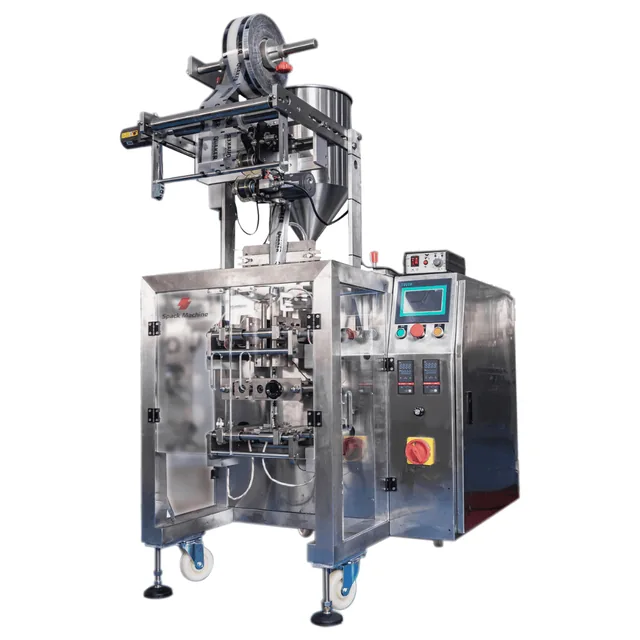
Machine reference. The Stage 1 photograph shows a VFFS machine. The following steps describe the packing sequence; the forming and sealing setup must be matched to your bag and film.
The machine forms the bag from a roll of film, fills it and cuts the finished pack.
Film structure, roll width, core, outer diameter, unwind direction and the eye-mark still have to be confirmed with the finished-bag drawing. They are not the same input as bag width.
The bag arrives already made. The machine only opens, fills and seals it.
If you buy zipper, stand-up or other premade pouches, you are on the rotary or horizontal premade family — not a 3-side VFFS host.
04
What you can pack
Start with how your product flows and how it must be handled. A product name alone cannot confirm dosing accuracy or a clean seal.
Dust on the seal is the usual failure, not brochure speed. An auger route is a common starting point. Free-flowing and cohesive powders still need a sample. Industry notes: powder packaging.
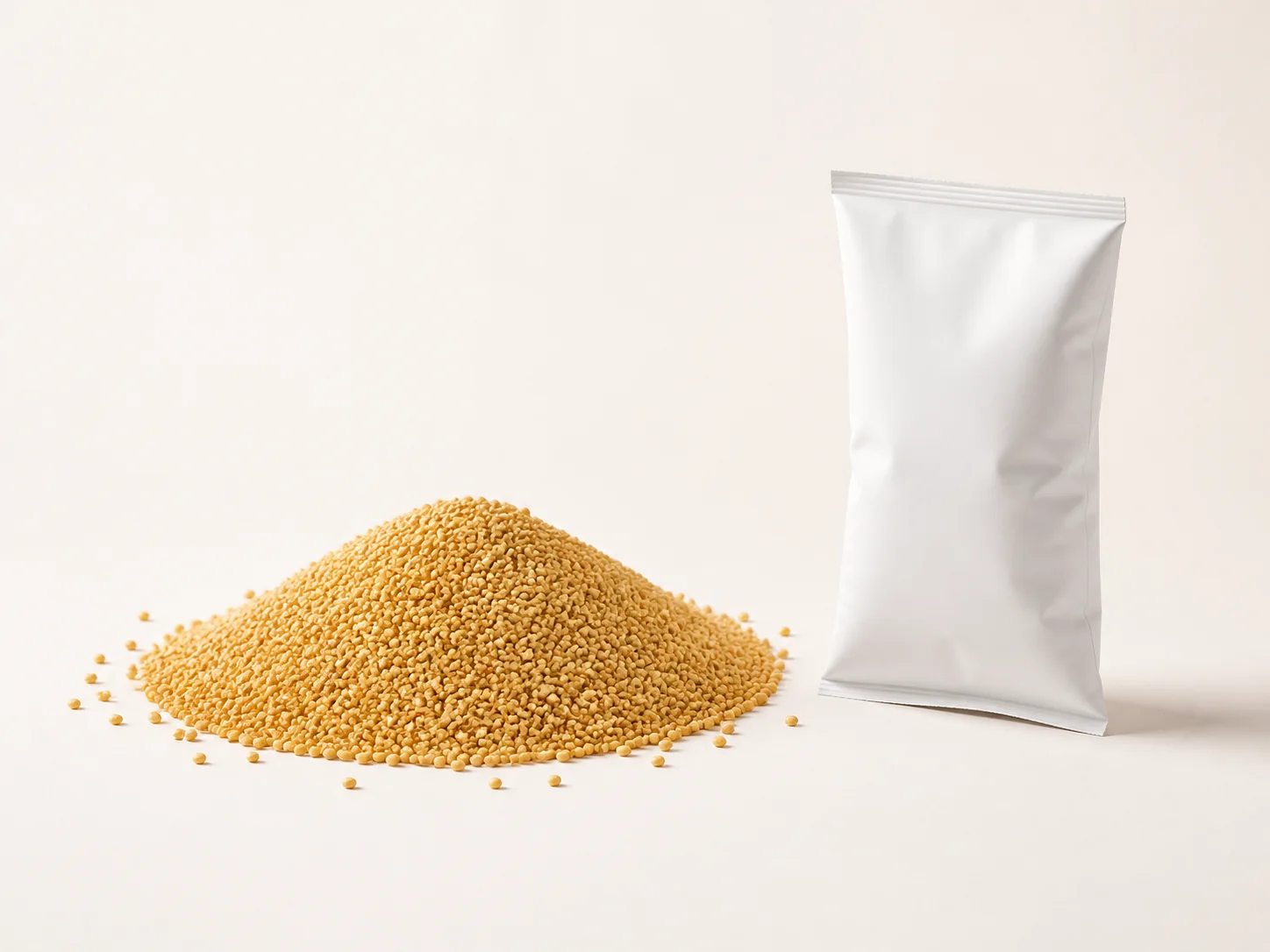
Cup, linear weigh or multihead weigh is chosen from piece size, fragility and target dose. Counting is a different question. Industry notes: granule and solid packaging.

Pump or piston routes follow viscosity, temperature, particles, foam and clean-down. A cream in a 3-side sachet still needs a sample. Industry notes: liquid and paste packaging.

If a feeding and dosing route can deliver the piece without damaging it or contaminating the seal, the VFFS host can be discussed. A name such as tablet or seed is not enough.
Screening images. Visual examples of product state, not measured particle-size, viscosity or hygiene specifications. Compatibility is confirmed by running your own sample. Pharmaceutical or nutraceutical projects require a separate review of hygiene, materials and documentation.
05
Compare machines
Compare the VFFS families below for your 3-side sachet. The bag drawing, dose and film determine the forming setup and filler; specifications for one configuration do not apply automatically to another.
VFFS-220 / 320 / 420
A roll-film machine family with forming setups for 3-side sachets, 4-side sachets, stick packs and pillow bags. Start with finished pouch width, then confirm the filler, forming setup and film together.
What the machine has to do
Unwind and register the web, fold one edge, seal the other three, receive the dose, cut. Premade zipper pouches are out of scope on this host.
Published screening figures
VFFS 320S / 420S / 620S
Compare the VFFS 320S / 420S / 620S series when reviewing output requirements and bag sizes. Use the model specifications on its machine page, then confirm the forming setup, filler and achievable rate for your product.
What the machine has to do
The machine forms, fills and seals roll-film bags. Check the finished width and length for your format; a family-wide size range does not mean every model or forming setup covers the full range.
Published screening figures
Initial selection. Use the listed widths to narrow the frame size, then confirm bag length, film, forming setup and filler together. The two machine series have their own specifications. Published speeds are a starting point for discussion; your product and finished bag determine the achievable production rate.
06
Compare formats
Compare 3-side, 4-side, stick, pillow and shaped sachets in the sachet guide. Once you have chosen the seal layout, use the VFFS pages to review the machine configuration.
| If the bag is | Open first | Then |
|---|---|---|
| 3-side sachet (this page) | Stay here for anatomy and the fold-edge drawing | VFFS-220 / 320 / 420 — published maxima 100 / 150 / 200 mm (3.94 / 5.91 / 7.87 in) |
| Still choosing 3-side, 4-side or stick | Sachet packaging machine | Come back to this hub only after the drawing shows a folded edge |
| 4-side sachet | 4-side sachet guide | Compare the VFFS families with the appropriate forming setup |
| Stick pack | Stick hub | Not a skinny 3-side sachet |
One former is not every sachet. Pillow, 3-side, 4-side, shaped sachet and stick do not share one universal forming and sealing route. Dual-inch figures above are conversions of the published millimetres — not a US standard claim.
Compare formats
If you are unsure which bag format you need, start with the sachet guide and compare the seal layouts.
Open the sachet hub07
Project inputs
Start with a photo or sample of your pack, the product, the fill amount and your target output. Send the details you already have; missing film or machine information can be clarified during selection.
Sample validation. Compatibility is confirmed with a production-representative product sample and your intended film. A product name or a photograph alone does not confirm dosing or sealing.
08
Before you order
Spack Machine builds these machines in Shantou, Guangdong, China. Before ordering for a US, UK or Australian plant, confirm utilities, documentation, acceptance testing and shipping responsibilities in writing.
Confirm supply voltage, phase, frequency and compressed-air requirements for the quoted configuration. For example, a US 480 V / 60 Hz supply or a UK 415 V / 50 Hz supply must be checked against your site and the machine specification; neither is a default compatibility claim.
Powders cake, films slip and seals weaken when the plant runs humid. If that is your room, raise it early — it affects sustained output more than peak rate.
Decide which certificates and food-contact declarations you need on arrival, and who issues them — the machine builder or the film supplier. This page does not claim a destination-market approval.
Agree what the machine has to demonstrate before it ships — which product, which film, which bag, what weight tolerance — and that it runs your sample, not a generic one. That is the FAT conversation.
Crated dimensions and weight drive freight; the HS classification drives duty. The customs clearance walkthrough lists what a US, UK or Australian broker will ask for.
List wear parts and the change parts for each bag size, and include their cost and delivery arrangements in the quotation. The VFFS page states a 12-month warranty from receipt, with freight for replacement parts paid by the buyer.
Before you order. Confirm lead time, installation and after-sales responsibilities in your quotation. The packaging machine buying guide covers the questions to work through with your supplier.
09
Common questions
Answers to the questions buyers ask when comparing bag formats, machine configurations and project costs.
A 3 side seal pouch packaging machine is a rollstock form-fill-seal host that makes a flat sachet with one folded edge and three sealed edges, then fills and cuts it.
Spack Machine offers this format on VFFS configurations with a 3-side forming setup. Review the VFFS pouch section to compare frames, then confirm your bag, film and filler together.
A 3-side sachet has one folded edge and seals on the other three. A 4-side sachet is sealed on every edge — it is not a 3-side bag with one extra seal added later.
For a closer look at seal layout and pack presentation, read 3-side vs 4-side seal: key insights. Open the 4-side sachet guide if every edge is a seal.
No. A stick pack is a narrow tube with a back seal and two cross seals. A pillow is a wider tube with a longitudinal back fin.
A pouch with a longitudinal back fin seal is a pillow pouch. A narrow tube with a back seal is a stick pack. Neither has the folded-edge structure of a 3-side sachet.
Not always. A making machine / converter produces empty pouches. A 3-side pouch packaging machine forms, fills and seals from roll film in one line.
If you only need empty 3-side bags, say so in the enquiry. Do not force a converting RFQ onto a VFFS host.
No. A side sealer in shrink-tunnel language is a different machine. A flow-pack / flow-wrap machine wraps a solid piece in a horizontal pillow.
For individual solid pieces, compare the flow-wrap machine; for vertically filled back-fin bags, see the pillow pouch guide. A horizontal rollstock 3-side sachet machine is a different family and is not currently listed by Spack Machine.
Zippers and spouts are not listed as standard options for this configuration. If either is needed, compare the premade pouch routes below.
Open the rotary or horizontal premade host, or the doypack guide. Confirm the pouch structure and closure with the machine configuration.
A cream is a liquid/paste dosing question, not a unique “creams 3 sided sachet machine”.
Pump or piston selection depends on viscosity, temperature, particles, foaming and cleaning requirements. Test your product and film together on the proposed VFFS configuration before confirming dosing and sealing.
Screening figures live on the VFFS page: a headline of up to 70 bags per minute, and a typical 15–60 packs per minute range. Both are orientation, not a guaranteed production rate.
Actual output depends on dose, bag length, film, sealing time, filler and product behaviour. Compare quotations using the same product and bag, including sustained output per shift.
No figure on this page would be meaningful, because price follows the finished pack, the filler and the stations around it.
A plain 3-side sachet, the same bag plus coding and cartoning, and a 4-side or stick line sit at different levels. Fix bag, fold edge, dose, film and output per shift, then ask for a comparable quotation.
No. Finished width and length describe the bag you sell. Roll width, repeat length and the eye-mark describe the web that makes it.
Send both. Treating them as one number is a common reason a former does not match the artwork. Published maxima are 100 mm (3.94 in) on VFFS-220, 150 mm (5.91 in) on VFFS-320, and 200 mm (7.87 in) on VFFS-420.
No. Pillow packs, 3-side sachets, 4-side sachets, shaped sachets and stick packs do not share one universal forming and sealing route.
One line normally covers one inner-bag geometry and its close variants. If you sell two formats today, expect to compare two forming sets on the sachet guide.
Spack Machine builds these machines in Shantou, Guangdong, China, for export to the destination agreed in your order.
For an imported machine, confirm your destination, site utilities, required documentation and local installation arrangements before ordering.
A drawing that marks which edge folds, finished width and length, product and dose, film-roll data, and bags per shift.
Tear notch, coding and secondary pack are questions — mark them unknown if you do not have them yet. A production-representative sample confirms dosing and sealing; a photograph does not.
10
Read next
Compare bag formats, review machine specifications and prepare the details needed for a quotation.
Compare formats
3-side, 4-side, stick, pillow and shaped — then the same two VFFS pages.
Vs article
Compare seal layout, pack presentation and the details to confirm before choosing a format.
Sibling
Sealed on every edge. Dedicated web and tooling — not this folded-edge pack.
Machine
Pouch formats, frame widths and specifications for choosing a VFFS configuration.
Stick
Narrow tube with a back seal. Not a skinny 3-side sachet.
Pillow
A tube-shaped pack with a back fin seal and top and bottom seals.
11
Next step
Tell us the 3-side sachet you sell, which edge folds, the product going into it and the output you need. That is enough to put you on the right VFFS page.
Project confirmation. Machine, forming set, filler and output are confirmed against your samples and site conditions before anything is quoted as final.