Premade pouch routes

Premade Bag Packaging Machines

Choose a rotary or horizontal machine around your pouch, product and changeover needs.

A premade bag packaging machine opens, fills and seals pouches that are already made. Compare rotary and horizontal (linear) machines below, then select the filler for your powder, granules or liquid. Your pouch sample, fill quantity and required output determine the final configuration.

Using roll film instead of finished pouches? Explore sachet, stick and pillow packaging. For premade stand-up, gusset and flat-bottom pouches, start with the opening and changeover comparison below.

Printed stand-up pouch with zipper, shown as a premade bag that arrives already made
Illustrative stand-up pouch reference. This image shows the bag format, not a customer production sample.
Best fit
Brands and co-packers comparing automatic filling and sealing for purchased pouches, with the machine and filler selected around their product.
Compare before you buy
Use the premade buying guide to compare the pouch, machine, filler and quotation scope before choosing a line.
Start with
The pouch (W×L, bottom style, zipper if any), the product and dose, how many widths you will run, and pouches per shift.

01

Rollstock vs premade

What premade bag packaging actually means

The first choice is how the bag reaches the machine: as roll film to be formed on the line, or as a finished pouch ready to open, fill and seal.

Roll film — form, fill and seal

Form-fill-seal equipment makes the pack from roll film. The equipment family depends on the product and final format: a stick pack, sachet or pillow pack needs its own suitable forming and filling arrangement.

Premade — magazine, not a collar

A premade bag packing machine takes finished pouches from an infeed, opens them, receives a dose from the selected filler and seals them. Rotary and horizontal machines handle this sequence with different pouch-opening and changeover arrangements.

Next, compare the handling method. Start with rotary for automatic gripper-width adjustment, or compare horizontal suction-cup opening for your pouch. Both need a pouch-specific configuration check.

02

Machine comparison

Rotary or horizontal: compare pouch opening and changeovers

Compare the number of pouch widths you run, how the bottom gusset opens and the filler your product needs. These requirements are more useful than choosing from the word “premade” alone.

Initial selection criteria. Confirm the pouch, included equipment and changeover requirements in the project quotation.
DecisionRotary premadeHorizontal premadeWhy it matters
Width change The operator enters the pouch width; gripper arms reposition automatically. Other changeover tasks still depend on the pouch and filler. Width adjustment is manual and comparatively involved; review it carefully if you change widths frequently. For several pouch widths per shift, compare the rotary adjustment process first.
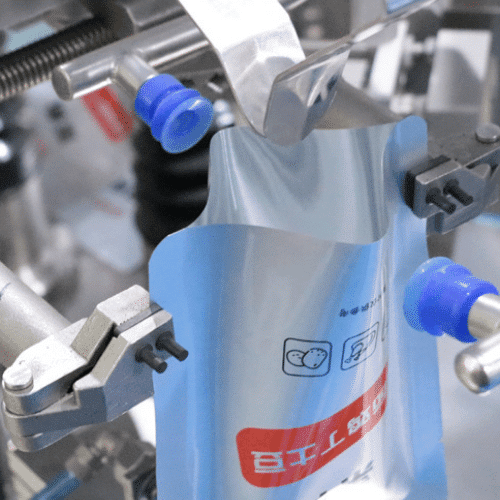
Opening the pouch Grips both sides. Some M-shaped / gusset pouches may not expand fully. Suction cups can pull the pouch faces fully open, which can help with M-gussets. Confirm on the actual sample. Stand-up pouches may suit either layout. For an M-fold base, compare opening on both machines using your pouch sample.
Layout Eight-station rotary. Linear magazine: pick, open, fill and two-step sealing. Check the complete line layout, including filler access, conveyors and available floor space.
Zipper opener Confirm from the real pouch. Not assumed on every quotation. A zipper-opening device is optional; confirm it in the quoted configuration. A zipper on the artwork does not prove the host includes an opener.
Line price (qualitative) Generally above the horizontal host for a comparable project. Generally priced slightly below rotary. Final line price still depends on filler, options and scope. Do not pick a host from a website price. Ask for an itemized quotation on the same pouch.

Compare the complete line. The premade pouch filling machine buying guide explains what to compare before ordering. Ask each supplier to quote the same pouch, product, filler, options and required output.

03

The two machines

Choose a machine family, then check the frame and configuration

The rotary and horizontal pages provide their own reference frames and specifications. Use the comparison here to choose which to investigate, then check the pouch dimensions, opening method, filler and test conditions before selecting a model.

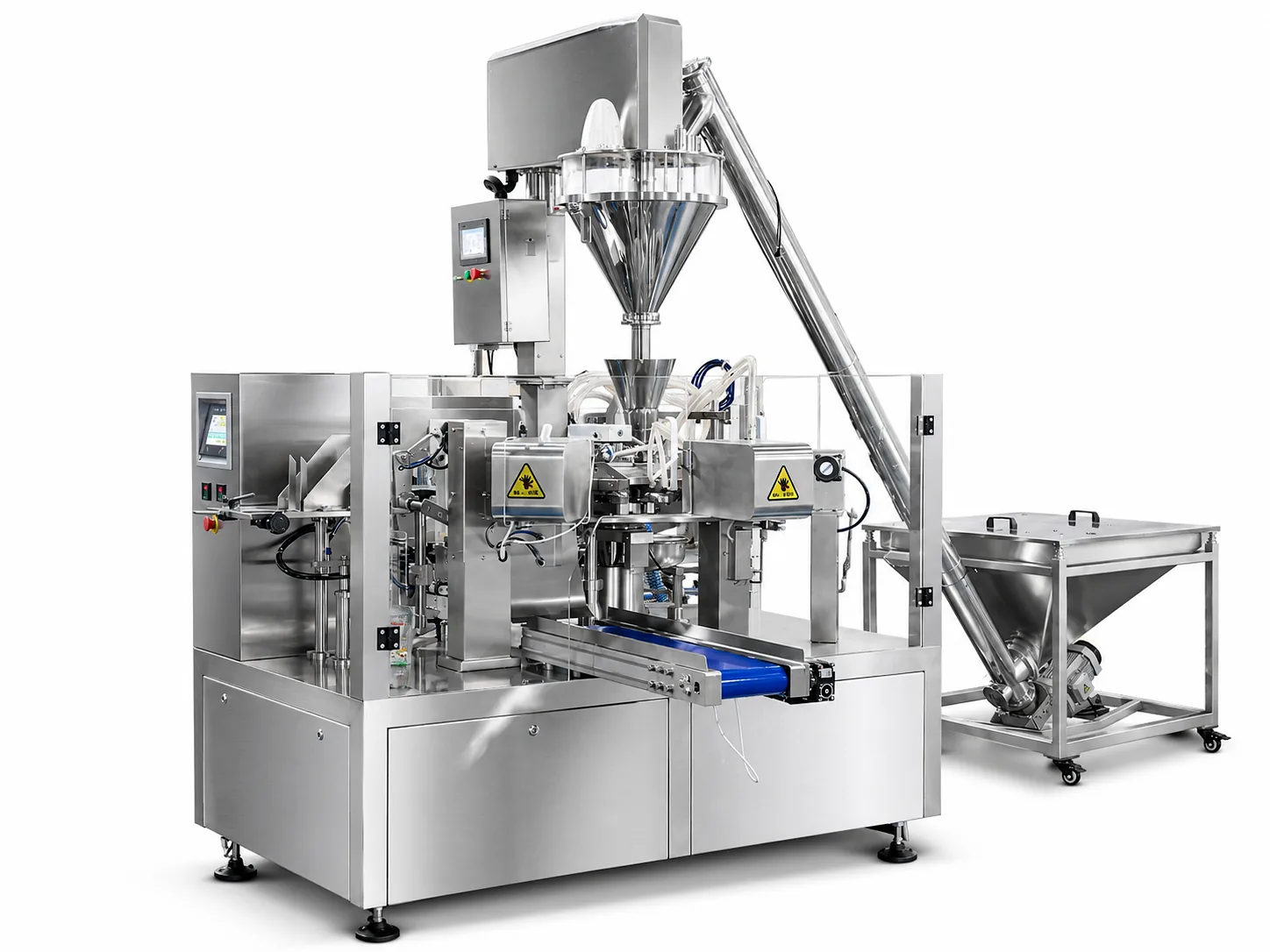
Published rotary premade bag packing machine, used as a family reference photograph
Published rotary premade-bag family reference. Not a quoted configuration.

200 / 250 / 320 / 350 reference frames

Rotary premade bag packing machine

Eight-station rotary pouch handling with automatic gripper-width adjustment. Compare this family when you expect to run several pouch widths; confirm the remaining changeover tasks and pouch-opening result for your project.

What the machine has to do

The host handles the pouch; the filler meters the product. Review the zipper, spout and bottom construction separately, then confirm the opening and sealing arrangement with the intended pouch.

Published screening figures

Pouch width screen
Four reference frames are listed on the rotary machine page.
Compare the width and length ranges against your pouch drawing.
Stations
Eight stations on this family
Headline speed
Check the machine-page references, then confirm output using your product, pouch, dose and selected filler.
Warranty
12 months from receipt;
spare-parts freight is the buyer’s during that period
What to send
Pouch drawing, zipper/spout, product, dose, pouches/shift
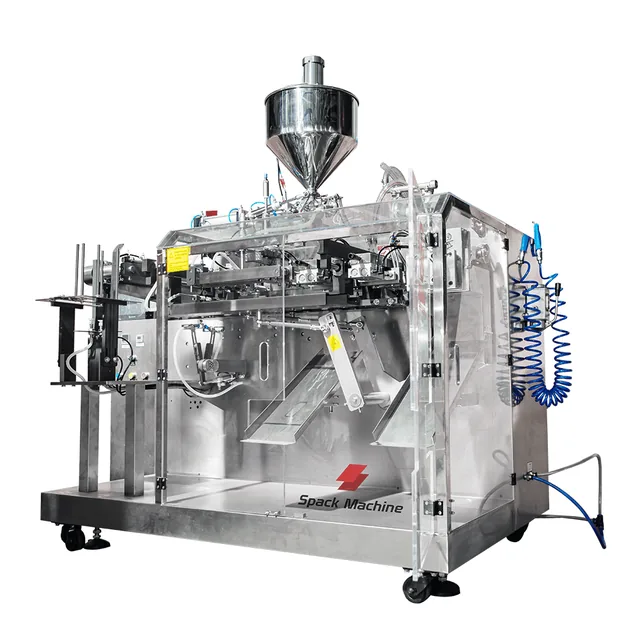
Published linear premade bag packing machine, used as a family reference photograph
Published linear magazine host. Family reference photograph, not a quoted configuration.

SPM-160 / 210 / 260

Horizontal premade bag packing machine

Linear pouch handling with suction-cup opening and manual width adjustment. Compare this family for M-gusset opening or a linear line layout, and review the practical changeover work if you run several pouch widths.

What the machine has to do

The machine opens, fills and seals premade pouches. A zipper opener is optional, and the filler is selected and quoted separately.

Published screening figures

Pouch width screen
160: up to 160 mm (6.30 in)
210: up to 210 mm (8.27 in)
260: up to 260 mm (10.24 in)
Family bag-size range
110 × 90–360 × 260 mm
(4.33 × 3.54–14.17 × 10.24 in)
Headline speed
Published speed references differ. Confirm the agreed production output through the selected product, pouch, dose and filler.
Warranty
12 months from receipt;
the buyer pays replacement-parts freight during that period
What to send
Pouch sample, bottom style, zipper/spout, dose, pouches/shift

Use reference specifications for initial screening. They do not confirm a pouch merely because its width fits. Check its length, laminate, gusset, zipper and opening method, then agree output and acceptance conditions for the selected filler.

04

Which pouches

Formats these hosts consider — and formats they do not

Start with the physical pouch: its bottom construction, opening, zipper and finished dimensions. These details help determine whether rotary or horizontal handling is worth testing. Roll-film formats follow a different equipment selection path.

Stand-up doypack format reference

Stand-up / doypack

A bottom-gusset pouch supplied ready-made. Confirm its opening and sealing requirements, including any zipper-opening device.

Side-gusset pouch format reference

Gusset

Side, bottom or M-fold constructions need different opening checks. Compare horizontal suction-cup opening on the actual M-gusset sample.

Quad-seal flat-bottom pouch format reference

Block-bottom / box

Confirm the exact bottom construction and how the empty pouch opens. Use a sample to compare the two handling methods.

Four-side-seal sachet shown as a format these hosts do not replace

Not a typical sachet

Typical sachet and stick-pack projects use roll film. Choose the relevant forming and filling equipment rather than assuming the format belongs on a premade pouch machine.

Distinguish purchased pouches from packs formed from roll film before choosing equipment.
Finished bagOn this category?Packed on this siteOpen
Stand-up / zipper / gusset / block-bottom Yes — after a pouch sample Rotary or horizontal premade. Filler is separate. Compare rotary or horizontal handling; use the format pages to review pouch construction.
Stick pack No — not a default premade format VFFS stick forming set Stick pack machines
Typical 3-side or 4-side sachet No — formed from film VFFS 3-side or 4-side family 3-side or 4-side hub
Pillow from roll film No — that is VFFS (or flow wrap for a solid piece) VFFS pillow family, or flow wrap Pillow packaging

Format references. These images illustrate pouch shapes, not customer samples or compatibility tests. Confirm the opening and closure features with your actual pouch.

05

How the cycle runs

Magazine, open, fill, seal — six process steps

These six steps explain the pouch journey, not the number of machine stations. The actual station sequence, date coding, gas flush and zipper-opening equipment depend on the selected configuration.

Linear premade pouch host with bag magazine, family reference

Stage 1

Load the magazine

Premade pouches sit in a magazine or on a rotary infeed. You buy pouches, not a film roll. Magazine geometry still has to match the pouch.

Published linear premade host, used as a pick-and-magazine family reference

Stage 2

Pick the pouch

The host takes one pouch from the stack. Include date coding in the project scope if required.

Pouch opening station on a published premade host

Stage 3

Open — and gas only if specified

Check that the intended pouch opens far enough for the filling arrangement, especially with an M-gusset. Horizontal suction cups can help open the faces; confirm gas-flush requirements separately.

Granule product used as a filling-state screening example

Stage 4

Dose the product

Discuss an auger for cohesive powder or an electronic scale for free-flowing powder, a weighing system for granules, or a product-specific pump for liquid or paste. These are filler selection routes, not included equipment or a compatibility guarantee; confirm against the product sample and target dose.

Finished stand-up pouch format reference after sealing

Stage 5

Clean the seal face, then seal

Check whether product can reach the seal area and whether cleaning is needed before sealing. Confirm the selected sealing process and any cleaning equipment with the intended pouch and product.

Published rotary premade host used as a discharge-family reference

Stage 6

Discharge

The finished pouch passes to the conveyor, checkweigher or cartoning equipment included in the project scope.

Equipment and format references. The images illustrate the process and machine families. They do not show every quoted option or document a customer acceptance test.

06

Vs rollstock

Premade pouches or VFFS: choose how the bag is made

Compare the finished pack, packaging-material supply and required output before choosing between purchased pouches and roll film. Then compare quotations for the complete line.

Stay on premade when

You already buy or will buy finished pouches — stand-up, zipper, gusset or block-bottom — and the machine only has to open, fill and seal them.

Leave for VFFS when

You plan to form and fill suitable bags from roll film. Review the vertical form-fill-seal machine page for its supported formats, reference frames and filling arrangements.

Compare cost per finished pouch. Use the same product, pack specification and required output when comparing packaging-material use, machine scope and operating requirements.

Buying guide

The buying guide covers the questions behind a rotary or horizontal selection, and the quotation details to compare before ordering.

Open the premade buying guide

07

Project inputs

What to define before asking for a configuration

Use these eight inputs to prepare a configuration discussion. Send the information you have and mark any values that still need to be confirmed.

01
Pouch drawing or sampleFinished width and length, bottom style (stand-up, M-fold, box/flat-bottom), and whether a zipper or spout sits on the pouch.
02
How many widthsList each pouch width and how often it changes. Rotary gripper-width adjustment is automatic; horizontal width adjustment is manual.
03
Product statePowder, granule or liquid/paste — plus dust, viscosity, particles and whether it bridges or foams.
04
Fill weightTarget grams or millilitres per pouch and the acceptable fill tolerance. The selected filler and product test must support the agreed target.
05
GasWhether the pouch is simply opened, or needs a gas flush. Do not assume nitrogen as standard.
06
Target outputPouches per shift and how many shifts, rather than a peak bags-per-minute figure copied from another page.
07
Zipper opener / codingPresent or not. A zipper on the artwork is not an included opener. Date coding is a station to confirm.
08
Site utilitiesThe voltage, phase, frequency and compressed air the building actually supplies — not a number inferred from a website.

Sample validation. Use representative product and intended pouches to check opening, filling and sealing. Agree the required trials, change parts, changeover tasks and acceptance criteria before confirming the configuration.

08

Before you order

What to confirm when you import the machine

Spack Machine is based in Shantou, Guangdong, China. Before ordering, confirm the complete machine scope, site utilities, required documentation and acceptance arrangements in writing.

Power and utilities at your site

Confirm supply voltage, phase and frequency against the configuration, along with compressed air. Do not infer a US 480 V / 60 Hz or a UK 415 V / 50 Hz supply from a website.

Ambient humidity

Share the expected temperature and humidity, especially for moisture-sensitive products or pouches. Discuss how to check performance under your conditions; the humidity and pouch-machine output guide provides questions to review.

Documentation for your market

Decide which certificates and food-contact declarations you need on arrival, and who issues them — the machine builder or the pouch supplier. This page does not claim a destination-market approval.

Shipping, duty and clearance

Crated dimensions and weight drive freight; the HS classification drives duty. The customs clearance walkthrough lists what a US, UK or Australian broker will ask for.

Acceptance before dispatch

Agree what the machine has to demonstrate before it ships — which product, which pouch, what weight tolerance — and that it runs your sample, not a generic one.

Spares, tooling and format change

List wear parts and the change parts for each pouch width you plan to run. Warranty on the premade hosts is 12 months from receipt; freight on replacement parts during that period is the buyer’s.

Confirm the written scope. Lead time, installation arrangements and service responsibilities are agreed per project. The packaging machine buying guide can help you prepare these questions before ordering.

09

Common questions

Premade bag packaging machine FAQs

Answers to common selection questions about pouch handling, fillers, changeovers and the information needed for a quotation.

What is a premade bag packaging machine?

A premade bag packaging machine fills and seals pouches that were made before they reach the line. The host opens the pouch, doses the product, then seals it.

Spack Machine offers rotary and horizontal pouch-handling arrangements. The filler is selected separately for the product, while the pouch determines the opening and sealing requirements.

When should I compare rotary or horizontal machines?

Start with rotary when you expect frequent pouch-width changes: the operator enters the width and the gripper arms reposition automatically. Compare horizontal suction-cup opening for an M-gusset, while checking the manual width-change work.

A stand-up pouch may be considered on either machine. Confirm the actual pouch-opening result, product filler, complete line layout and changeover requirements before choosing.

Can these machines fill premade doypack pouches?

Premade doypack pouches can be evaluated for rotary or horizontal handling. The bottom construction, zipper, dimensions and opening must be checked on the actual pouch.

Review the doypack pouch format, or compare gusset and flat-bottom construction before sending a sample.

Premade vs VFFS?

Premade buys finished pouches and only fills and seals them. VFFS forms the bag from roll film on the line.

Compare the pack specification, material supply and required output. Use the premade buying guide to prepare a like-for-like equipment comparison.

What speed can I expect?

Production output depends on the pouch, opening, product, dose, filler and sealing conditions. Reference speed is an initial screening value, not an agreed result for your product.

The horizontal page contains differing published speed references. Ask for an agreed output and test method using your intended pouch and product, including the required pouches per shift and changeovers.

How much does a premade bag packing machine cost?

The quotation depends on the pouch-handling machine, filler, opening and sealing requirements, and any additional equipment.

Send the pouch drawing, product, target dose and required output. Compare itemized quotations for the same scope, including options, change parts, tests and delivery responsibilities.

Is a zipper opener included?

A zipper on the pouch does not mean a zipper-opening device is included with the machine. Provide the actual pouch and confirm the required opening equipment in the quotation.

The horizontal machine lists zipper opening as an option. For either machine, confirm how any zipper, spout or other pouch feature affects handling and filling.

Is stick pack premade?

Typical stick packs are formed from roll film rather than supplied as finished pouches for a magazine.

For that format, review the stick pack machine page and confirm the forming and dosing arrangement.

What is an inline premade pouch machine?

A horizontal or linear premade machine moves pouches along a line through picking, opening, filling and sealing. A rotary machine moves them around its stations.

On this site that is the horizontal premade bag packing machine. Width change on that host is manual.

What changes when I switch pouch widths?

On the rotary machine, entering the width repositions the gripper arms automatically. Horizontal width adjustment is manual and comparatively involved. Neither step defines the complete line changeover.

Provide every intended pouch size and the change frequency. Confirm the parts, operator tasks and changeover time with the selected pouch-handling and filling configuration.

Where is Spack Machine based?

Spack Machine is based in Shantou, Guangdong, China.

Share your installation country and site requirements so the quotation can address power, documentation, shipping and the agreed service scope.

What do you need from me to recommend a configuration?

A pouch drawing or sample (W×L, bottom style, zipper/spout), a production-representative product sample, the target dose, how many widths you will run, and pouches per shift.

Include site power and floor dimensions. Mark information that is still undecided so it can be resolved before the configuration is confirmed.

10

Read next

Explore machine specifications, pouch formats and buying advice

Open a machine page for its frame references and configuration details, a format page for pouch construction, or the buying guide for quotation and selection questions.

Format

Doypack packaging machine

Review stand-up pouch and bottom-gusset construction before selecting the opening arrangement.

Roll-film alternative

Sachet packaging machine

Explore roll-film sachet formats and their forming and filling requirements.

11

Next step

Send your project details

Send your pouch drawing or sample, product, target fill quantity and required output. We can use these details to discuss rotary or horizontal handling, the filler and the checks needed before confirming a configuration.

Project confirmation. Host, opener, filler and output are confirmed against your pouches and site conditions before anything is quoted as final.

Back to top
Got a packing idea? Say hi — no need to have everything ready.