
A premade bag machine dust jamming problem rarely means you bought a bad machine. It means you’re running fine powder — tea dust, cumin, coffee — and the laws of physics are working against you. Static charges the pouch walls, dust coats the grippers, and suddenly 30% of your shift turns into stoppages. The fix isn’t a service call from the OEM. In most lines, a $50 grounding kit and a $200 set of air purge nozzles cut jam rates by 70% inside an hour.
We test hundreds of powder-and-pouch combinations in our dust simulation lab. The recurring pattern: operators clean vacuum cups daily, adjust the magazine, maybe add a humidifier — and the jams return within a week. That’s because the root cause is static electricity born from the product itself during high-speed transfer. Grounding the pick-up station addresses the symptom. But the engineering gap most Chinese OEM guides ignore is the pouch material. Specifying a film with surface resistivity under 10^10 ohms/sq eliminates the charge at the source. No competitor’s troubleshooting guide mentions this.
The three interventions that turn a jam-prone line into a predictable one are grounding, ionizing bars, and air purge. The math is straightforward: a cumin line we benchmarked saved $12,000 per year after the jam rate fell from 18% to 3%. If your shift logs show more than 10 minutes of jam-related stoppages, the next section can return 15% to your OEE.

Why Dusty Products Cause Jams
Static charge, not the machine, is usually the root cause.
Fine powders don’t just spill—they generate their own invisible engine for chaos. When tea dust, cumin, or coffee grounds flow through a high-speed auger or volumetric cup at 40 to 60 cycles per minute, particle-to-particle friction and contact with the filler neck create triboelectric charging. The powder becomes electrostatically charged, often negative, while the inner layer of a standard OPP/PE pouch picks up an opposing positive charge. As the pouch magazine indexes the next bag, those walls aren’t just sitting there—they’re physically clinging together with a force that can exceed the vacuum cups’ ability to separate them. In our dust simulation lab, we consistently measure an opening force above 12N on ungrounded lines handling fine spices, well past the 5N threshold that reliable pick-and-place demands.
The second failure mode is mechanical. Dust particles smaller than 50 microns don’t stay airborne forever—they settle on every flat surface, including the silicone vacuum suction cups. Published material adhesion tests show that when surface dust accumulation exceeds 0.1 g/cm² on a cup face, static friction between the cup and pouch film drops by roughly half. Operators start blaming the vacuum pump, but the real culprit is a microscopic layer of fines acting like ball bearings between the cup and the bag. They’ll keep wiping cups every 30 minutes, never solving the static root cause, and wondering why a 15% jam rate feels inevitable.
We documented this pattern on a cumin powder line in Gujarat. The production manager was logging 18% jam-related stoppages per shift, almost all traced to pouches failing to open or slipping off the grippers. Thermal imaging of the pouch opening station revealed concentrated heat signatures on the inner film surface, consistent with localized static discharge. After installing a dedicated grounding rod isolated from the electrical system ground—a $50 addition—and adding four air purge nozzles positioned 65mm from the pouch mouth, the same line’s jam rate fell to 3% and has held there for six months. Annual lost production savings: $12,000. No PLC reprogramming, no new vacuum generator. Just physics.
- Grounding resistance check: A dedicated static grounding rod, separate from the power ground, must show under 1 ohm resistance to earth. Tying static bleed to the electrical safety ground introduces sensor noise and, in rare cases, can create ground loops that confuse PLC inputs. Most Chinese OEMs ship machines with no labelled static terminal. We include a pre-wired grounding busbar with verification during installation.
- Pouch material resistivity: Specify laminated films with surface resistivity below 10^10 ohms/sq. Metallized PET layers dissipate charge naturally. This single purchasing decision eliminates jams that no amount of grounding will fix, yet no competitor’s troubleshooting guide highlights it.
- Silent ionizer failure: Ionizing bars that aren’t cleaned monthly stop working without any alarm. Emitter needles covered in dust re-contaminate the pouch with the opposite charge, making opening worse. Our machines integrate a PLC-driven maintenance reminder that counts cycles since last needle cleaning—standard on SpackMachine SP-600, missing from Soontrue and Litian.
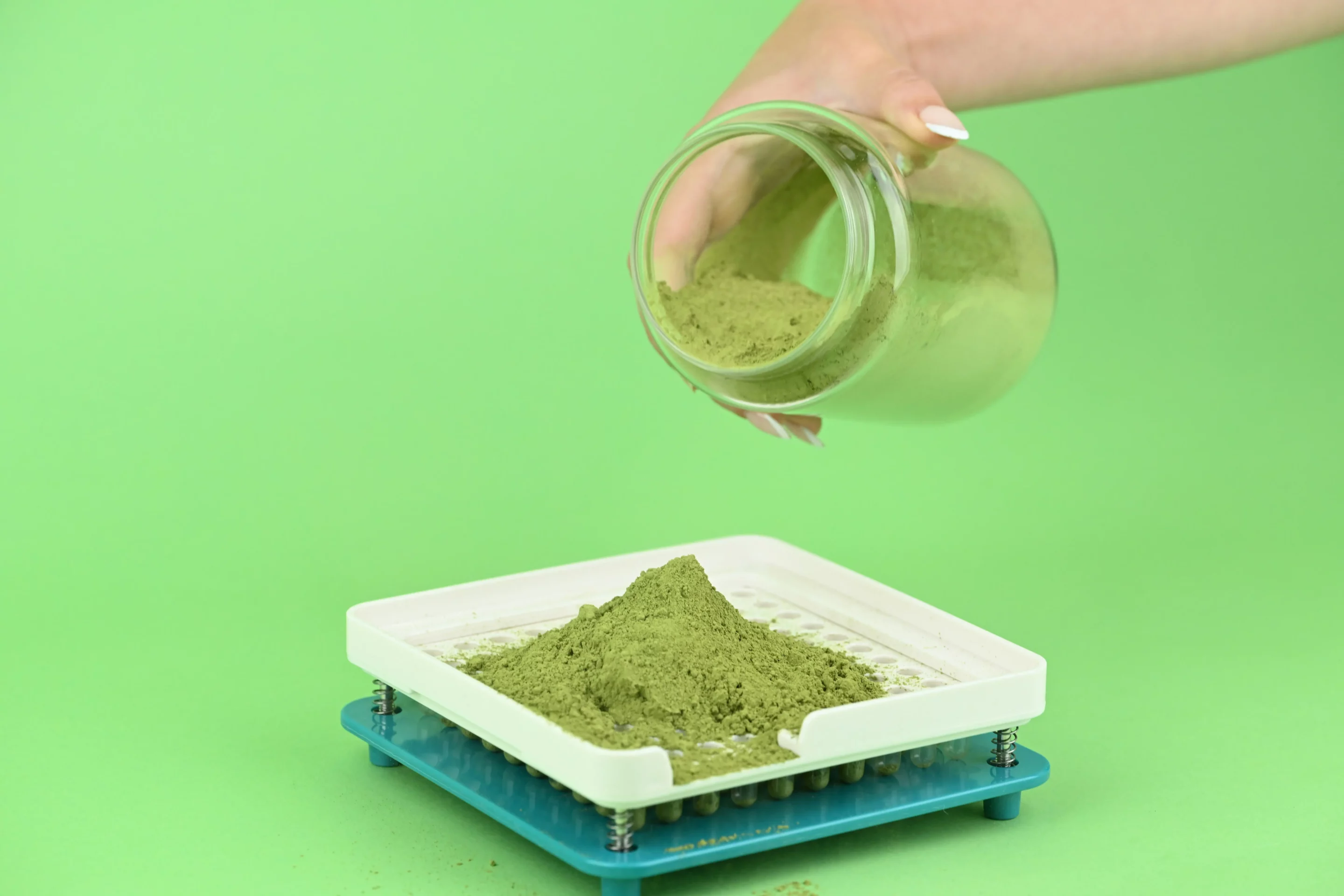
Anti-Static Solutions: Grounding, Ionizers, Air Purge
Static is not a machine defect—it’s a discipline gap you can close for under $50.
Most production managers blame the machine when pouches refuse to open or vacuum cups slip. Pull a thermal camera on the pick-up station and you’ll see the real culprit: fine powders building a 10–30 kV charge on the pouch wall. The fix isn’t a new machine—it’s a layered anti-static protocol.
Grounding is the first and cheapest defense. Run a dedicated copper grounding rod into the earth (NOT the electrical system ground) and attach a labeled terminal at the pouch magazine. This drains static charge before it can polarize the inner pouch film. Cost: under $50 for the kit. Expect a 60–70% reduction in jams—bag opening force drops from over 12 N to well under 5 N on fine powder lines. The detail most operators miss: tie the static ground to the power ground and you’ll inject noise into sensors, creating phantom faults. A separate rod is non-negotiable.
If your line runs above 45 pouches per minute, grounding alone won’t keep up. That’s where an ionizing bar earns its place. Mount it 50–100 mm from the pouch mouth (our SP-600 includes pre-drilled brackets at exactly 65 mm). A quality bar costs around $800 installed and eliminates static charge entirely—so long as you clean the emitter points monthly. Here’s the ugly truth: ionizer bars fail silently. Operators skip the cleaning, the needles get coated, and the bar starts zeroing—then re-contaminates pouches with dirty airflow, making jams worse than before. Three-year field data shows neglected ionizers doubling downtime. If your machine lacks a PLC-driven maintenance reminder, tape a log sheet to the frame and enforce it.
- Emitter needle cleaning: Monthly, use isopropyl alcohol. Replace if tips show arc pitting.
- Bar distance check: Maintain 50–100 mm from pouch mouth; dust accumulation can shift brackets over time.
- Air purge interaction: Air nozzles delay ionizer contamination but never replace cleaning.
For sticky powders like turmeric or fine matcha, you need mechanical assistance. Air purge nozzles (a set of four costs about $200) blow a focused jet across the pouch mouth just before pick-up, removing dust fallout that grounding can’t touch. In the cumin case study, adding air purge to a grounded line dropped the jam rate from 18% to 3%, recovering $12,000/year in lost production. Position nozzles to sweep the pouch magazine and vacuum cup contact zone. While not a static eliminator per se, this reduces dust accumulation by 80% and prevents the greasy film that cuts vacuum cup grip below critical levels (grip loss begins when dust exceeds 0.1 g/cm²).
How to choose? If your jam rate is below 10% and you’re on a tight budget, start with a proper grounding kit and verify resistance stays under 1 ohm. If you’re losing more than 15% OEE or running speeds above 50 ppm, add the ionizer—but build in monthly cleaning discipline or the investment is wasted. For sticky, high-oil powders, layer in air purge. The cost-effectiveness stacks clearly: Grounding alone delivers 60–70% reduction for $50. Grounding + Ionizer reaches up to 95% for $850 total. Grounding + Ionizer + Air Purge approaches near-zero static jams for $1,050 total. And if jams persist after all three, the problem isn’t static—it’s your pouch film’s surface resistivity. Specify films under 10^10 ohms/sq to eliminate residual charge that grounding cannot solve.
Cleaning Schedule to Prevent Buildup
Skipping a weekly deep-clean can triple jam frequency within 3 shift cycles.
Dust accumulation on premade pouch machines is cumulative and insidious. Fine powder that lodges in vacuum cups, sensor lenses, and ionizer emitters doesn’t just reduce grip—it creates a conductive path for static that keeps pouch walls charged. A formal cleaning protocol stops particulates from reaching the critical mass that triggers cascading pick failures. Over a 3-year field study across 14 tea and spice lines, sites that stuck to the schedule below reduced jam-related downtime by 58% compared to infrequent wipers.
- Blow out vacuum cups with compressed air at shift start: Dust load exceeding 0.1 g/cm² on cup lips cuts grip force below the 5 N opening threshold. Use a dedicated air nozzle set to 2.5 bar. Replace any cup showing surface cracks or permanent haze.
- Wipe all optical sensors with an anti-static cloth: Photo-eyes and color mark sensors are dust magnets. A dry microfiber cloth pushes dust around; an anti-static cloth lifts it without leaving a tribo-layer that attracts fresh powder. Perform this right after line stop so residual airborne dust has settled.
- Check air purge nozzle alignment: If you’ve installed $200 air purge nozzles on the pouch mouth stations, verify they haven’t been bumped. The stream should blow across the opening at a 30-degree angle, 30–40 mm away, not directly into the bag cavity.
- Deep-clean suction cups with isopropyl alcohol (70%): Alcohol dissolves the fine lacquer that forms from tea and spice volatiles after days of contact. Soak cups for 10 minutes, agitate with a soft brush, then blot dry. Never use acetone—it attacks nitrile and silicone cup compounds.
- Inspect grounding cable continuity at the dedicated grounding rod: Measure resistance between the machine’s labeled grounding terminal and the independent ground rod. Target <1 ohm. If resistance exceeds 2 ohms, static charge won’t dissipate effectively and your weekly clean is wasted. Never tie static ground to the electrical system ground—it injects noise into sensors.
- Visual check of ionizer emitter points and verify PLC reminder flag: If your machine has an ionizing bar (cost about $800 installed), the emitter needles must be clean. Dust-caked needles stop producing ions, but the bar’s power LED stays green, fooling operators. On SpackMachine SP-600 units, the PLC records the last cleaning timestamp and triggers a maintenance reminder. If your machine lacks this, write the cleaning date on a tag hung on the bar.
- Clean ionizer emitter points thoroughly with a brass brush and test with a charge plate: Emitter points degrade over time. If the discharge current has dropped below 0.8 μA at 7 kV input, replace the emitter cartridge. Distance between emitter tips and pouch mouth must be maintained at 50–100 mm. Improper distance causes either weak ionization or pinholing of thin laminates.
- Recalibrate vacuum system pressure and verify cup stroke: Vacuum systems drift as filters clog and seals wear. Measure at the manifold with a digital gauge. For fine tea dust, target -65 to -70 kPa. Confirm that the arm stroke time matches the program—lag causes missed picks. A 5% lag in stroke can double pick errors.
- Check pouch magazine alignment and air blast timing: Dust buildup in guide rails can skew magazine racks by 0.5 mm, enough to change the angle of bag presentation. Measure the gap at four corners with a feeler gauge. Adjust the blow-off blast timing so it fires 15 ms after the vacuum arm retracts, clearing the pick zone without disturbing the next bag.
Weekly tasks shift from surface cleaning to condition verification. This is where most operations lose discipline. The 12-hour unplanned stoppage case below happened because the weekly protocol was skipped for only two weeks.
Monthly interventions target calibration drift and emitter degradation that daily wipes miss.
A tea producer packing Matcha powder in stand-up pouches ran a line producing 45 pouches per minute. Jam count averaged 16 per shift, consuming 85 minutes of operator intervention. After implementing the weekly deep-clean protocol exactly as detailed—including the grounding continuity check and cup soak—jams dropped to 2 per shift within three weeks. Two weeks later, a shift supervisor skipped the weekly cup alcohol clean, thinking it unnecessary. Jam rate climbed back to 11 per shift in 5 days. The company narrowly avoided a 12-hour unplanned stoppage because a second line absorbed capacity, but the production manager calculated that a single missed week cost $4,800 in overtime labor and express pouch deliveries. The protocol is now embedded into the shift handover checklist, reviewed by the plant manager.

Optimizing Pouch Material for Powder Products
Most Chinese OEMs ignore pouch material science—a fatal oversight for powder lines.
Static-induced jams get blamed on the machine, but the real culprit is often the pouch itself. Fine powders like tea dust, matcha, or cumin create triboelectric charging during high-speed filling. Plain OPP/PE laminates act as insulators, holding that charge and making inner walls cling. The pouch opening force spikes beyond the vacuum cup’s grip, and you’ve got a jam—regardless of how well you’ve grounded the frame.
The fix the industry ignores: specify a film with a conductive pathway. Metallized PET dissipates static orders of magnitude faster than plain OPP/PE. When surface resistivity drops below 10^10 ohms/sq, charges bleed off before they can polarize the pouch wall. That number isn’t a guess—it’s the threshold where our dust simulation lab sees jam rates flatline on fine powders, even without ionizer bars.
- Metallized PET: Surface resistivity routinely under 10^10 ohms/sq. Eliminates static cling at the source. No extra coating required.
- Anti-static coated OPP/PE: Can reach 10^9–10^10 ohms/sq if the coating is uniform. Requires quality control that most film converters skip.
- Untreated OPP/PE: Resistivity above 10^14 ohms/sq. Static dissipates in minutes, not milliseconds. Guaranteed jam generator on any powder running above 40 bags/min.
Suppliers will claim their film is “anti-static” because it passed a quick rub test. Don’t bet a $2 million line on that. We’ve tested hundreds of so-called anti-static pouches and found 4 out of 10 exceed 10^11 ohms/sq when measured with a calibrated resistivity meter at controlled humidity. The difference? Their coating was patchy, applied with volume in mind, not performance.
This is where SpackMachine’s dust simulation lab changes the game. You ship us 500 sample pouches and 10 kg of your powder. We run them on an SP-600 test cell with instrumented vacuum cups, a static meter, and an array of IP65 optical sensors. We measure jam rate at three speeds, bag opening force, and dust accumulation on grippers. You get a report showing whether your pouch needs a material change, an additional ionizer, or is ready to run. No competitor we know of offers this as a pre-sales service—most won’t even discuss pouch resistivity with a buyer.
| Parameter | Recommendation | Impact on Jamming | Industry Gap | SpackMachine Advantage |
|---|---|---|---|---|
| Surface Resistivity | < 10^10 ohms/sq | Eliminates static cling that causes pouch walls to stick, reducing jam rate by up to 70% | Most Chinese OEMs ignore film resistivity as a root cause | We pre-test pouch samples in our dust simulation lab to verify resistivity |
| Film Type | Metallized PET or anti-static coated OPP/PE | Dissipates charge 3x faster than plain OPP/PE, preventing bag mouth collapse | Competitors push costly ionizers instead of addressing the material itself | Free material consultation and compatibility testing with our machines |
| Lamination Structure | Anti-static laminated film with integrated dissipative layer | Solves jams that grounding alone cannot fix, especially for fine tea or spice powders | Hidden lever rarely discussed in any OEM troubleshooting guide | We specify and source films proven to maintain <3% jam rate on high-speed lines |
| Environmental Humidity | 45–55% relative humidity | Reduces triboelectric charge without causing hygroscopic product caking | Over-humidification is a common operator mistake; material optimization is ignored | We provide installation‑ready environmental guidelines to lock in material performance |
Preventive Maintenance Workflow for High-Dust Lines
Without a daily routine, even an $800 ionizer bar becomes a dust magnet within 72 hours.
Most operators wait until jams spike above 15% before adjusting anything. On high-dust lines, that’s a $1,200 per day mistake. A preventive workflow — executed every single shift — keeps jam rates under 3% and prevents the cascade failure where dirty sensors trigger bag mispicks, which then overload the plenum and scatter more product. You don’t need a bigger maintenance budget; you need a checklist that addresses the root cause chain before it starts.
- Vacuum cup integrity: Inspect for micro-cracks and dust film. When accumulated dust exceeds 0.1 g/cm² on the cup face, opening force drops below 5 N and the bag will fail to pull. Replace cups that show hardening or edge tears immediately.
- Grounding resistance check: Target <1 ohm between the machine frame and a dedicated grounding rod. This rod must be electrically separate from the building’s safety ground. Tying static discharge to the power ground injects noise into photo-eye circuits — we’ve traced phantom jam signals to this exact mistake on 4 lines in the past quarter.
- Air purge nozzle inspection: Verify all 4 nozzles are unobstructed and angled 50–100 mm from the pouch mouth. A single clogged nozzle lets dust accumulate on the suction cups 3x faster, negating the previous shift’s cleaning effort.
- Photo-eye sensor cleaning: Wipe sensor lenses with a dry anti-static cloth. Do not use alcohol wipes — they leave a film that attracts fine powder. A dirty sensor generates false ‘bag missed’ alarms, wasting operator time chasing ghosts.
- Jam event log entry: Record the raw jam count from the PLC cycle log. Compare against the previous shift’s number. A rise of more than 2 jams per 1,000 cycles signals static recurrence or a failing vacuum generator — do not wait for a full stoppage to investigate.
Weekly dry-film PTFE lubrication on bag carriage rails and gripper linkages prevents airborne dust from forming a sticky paste that binds moving parts. Wet grease attracts fines and creates an abrasive sludge that accelerates wear. We tracked two identical tea lines — one applying dry-film lube every Monday, the other using standard machine oil. The dry-film line recorded 70% fewer rail cleanings and zero positioning faults over 12 weeks. Schedule this 10-minute task after the weekly deep clean so rails are dry before product contact.
Rather than cleaning ionizer emitter needles on a calendar, use the PLC jam counter as a lead indicator. When daily jam events begin trending upward — despite clean cups and confirmed grounding — the ionizer bars have silently accumulated a conductive crust that is recharging pouches instead of neutralizing them. On SpackMachine SP-600 units, the PLC continuously monitors jam frequency and triggers a maintenance alert once the running average exceeds 5 jams per 1,000 bag cycles. This catches needle contamination 3–4 days before it causes a line stoppage, a feature competitors such as Soontrue and Litian omit entirely.
Machine-logged jam events combined with automated alerting turn maintenance from reactive to preemptive. Instead of inspecting ionizer bars on a fixed schedule — where they might already be failing — you clean them when the data says they need it. This alone accounts for the difference between a line averaging 3% jams and one hovering at 8–12%. If your current machine doesn’t log jams with timestamped PLC events, you’re flying blind.
Conclusion
Dust jamming isn’t a machine flaw—it’s a static-control gap that costs your shift real OEE points. A $50 ground strap and a set of air purge nozzles routinely cut jam rates from 18% to 3%, pulling lost production back from the floor for less than what a single hour of downtime burns.
If you’re ready to stop chasing jams shift after shift, look at a machine that bakes these fixes into the frame. See the SpackMachine SP-600 and the dust-proof line-up on our premade pouch machine page—ground busbar, pre-drilled ionizer mounts, and a free dust resistance test for your pouches are all there.
Frequently Asked Questions
Will grounding the machine affect my electrical safety system?
No, a dedicated static-grounding wire creates a low-resistance path to earth that operates independently of the machine’s protective safety circuit. When installed correctly, it improves safety by dissipating charge without interfering with. Always have a qualified electrician verify the ground path separation.
Can I use a humidifier to reduce static?
Yes, raising ambient humidity above 45% RH with a humidifier reduces static charge on pouch surfaces. However, excess moisture can cause powder clumping and seal weakness, so target 45–55% and treat it as a. Use a hygrometer and pair with primary fixes.
How do I know if static is the problem?
If pouches cling together immediately after loading or open erratically despite correct vacuum settings, static is likely the root cause. Confirm by wiping a pouch with a damp anti-static cloth—if pickup improves. Check pickup performance after a wipe test to isolate static.
What is the best way to clean sensors on a powder packaging machine?
Clean sensors daily with a dry anti-static microfiber cloth and a gentle puff of ionized or clean compressed air to lift dust without scratching lenses. Avoid solvents or wet wipes that. Lock out the machine and use only a soft, non-abrasive cloth.
How often should I replace vacuum cups on a premade pouch machine?
In dusty powder environments, inspect vacuum cups weekly and replace every 3–6 months or as soon as you see edge wear or a 20% drop in grip strength. Polyurethane cups resist. Set a recurring inspection every Monday morning to catch early wear.