
Manual packaging creates bottlenecks, uneven bag weights, and rising labor costs that disrupt your daily factory output. When orders surge, relying on hand-sealing leaves your team exhausted and your packaging inconsistent. A modern packing machine solves these operational headaches by synchronizing material feeding, accurate dosing, bag formation, and hermetic sealing into a reliable, repeatable packaging workflow.
A packing machine works by synchronizing five sequential stages: material feeding, product dosing, package handling or roll-film forming, heat or ultrasonic sealing, and discharge inspection. Rather than functioning as a single rigid device, the machine relies on specialized mechanical, pneumatic, and PLC-controlled modules configured specifically to match your physical product characteristics and target pouch format.
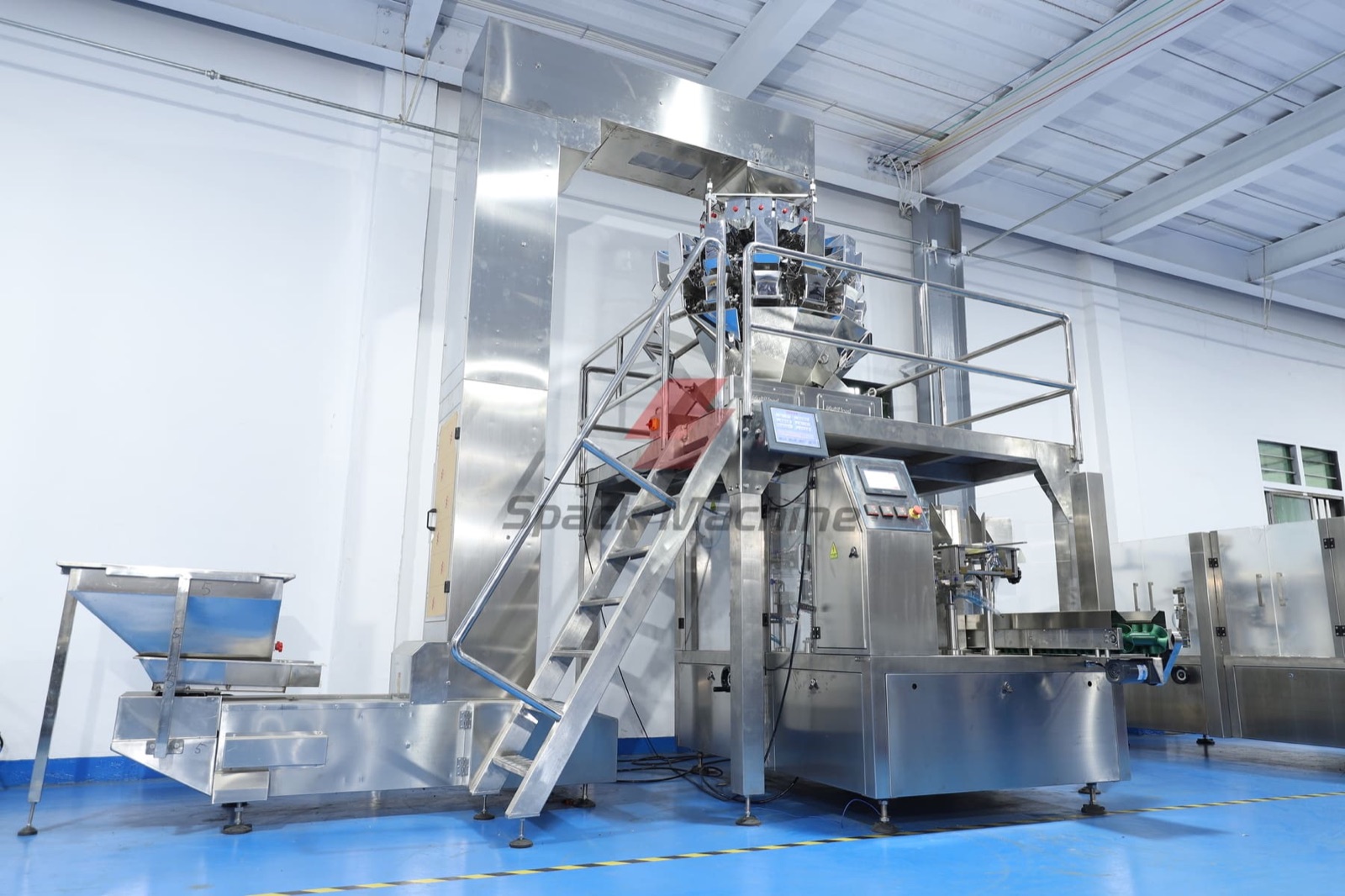
Many buyers assume a single machine handles any product straight out of the crate. In my daily work reviewing factory inquiries and running packaging trials, the reality is far more modular. Let us explore the internal mechanics, line modules, and critical engineering choices that define how these automated systems truly operate.
What are the core stages that make a packing machine work?
Buying an automated packaging unit without understanding its internal process leads to mismatched line speeds and costly factory floor jams. Unsynchronized components waste film and leave your operators constantly clearing mechanical errors. Understanding the sequential process stages ensures you invest in a balanced, fully integrated packaging system.
A packing machine operates through five linked stages: bulk delivery via an infeed conveyor, portion measurement by a dedicated filler, bag presentation or pouch forming from roll stock, thermal sealing of seams, and finished package discharge through checkweighing or metal detection units.
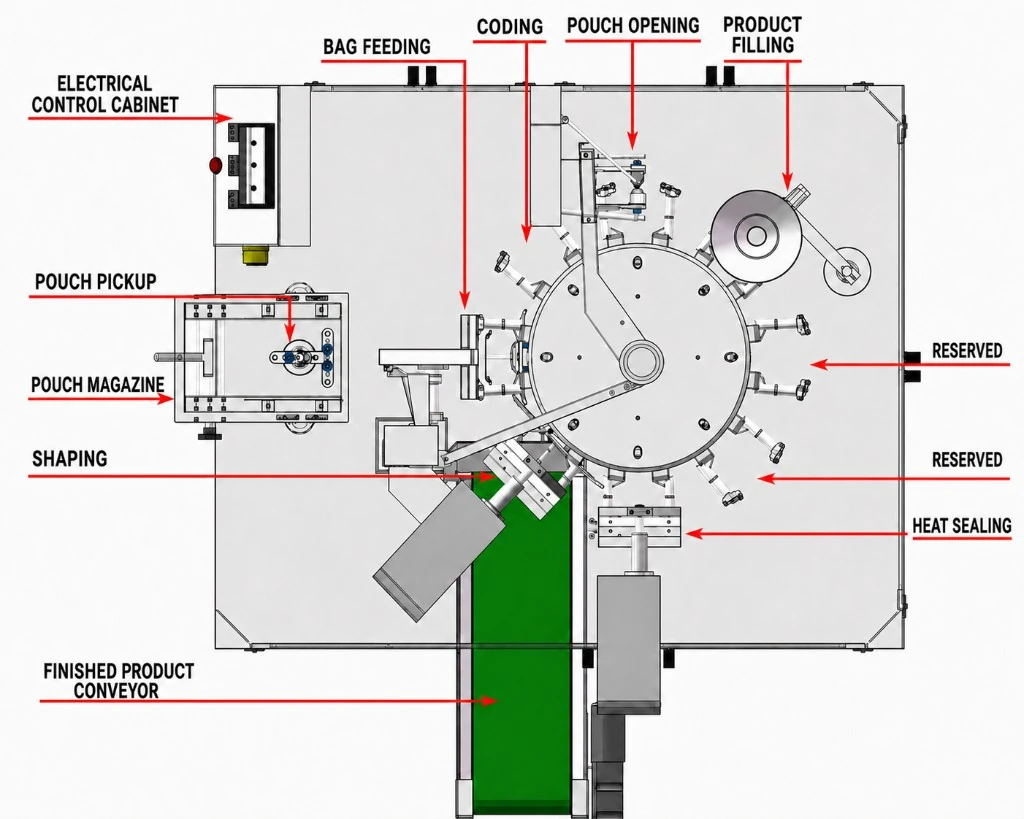
When clients ask me to configure a packaging system, I clarify early that the primary chassis does not accomplish the entire job alone. A complete automated packaging process operates through a coordinated chain of discrete assemblies. Each assembly handles one physical transition of the raw material or packaging film.
1. Infeed and Bulk Elevation
Bulk product starts in a ground-level supply hopper. An automated conveyor—such as an inclined Z-bucket elevator for solid snacks or a screw loader for non-free-flowing powders—elevates the product to the dosing platform. Level sensors inside the dispenser hopper trigger the conveyor motor automatically, maintaining a consistent head of material without human intervention.
2. Dosing and Metering
Once product reaches the top hopper, the machine meters precise product charges. The dosing device measures the targeted mass or volume before releasing it downward. Depending on whether you pack whole roasted coffee beans, fine collagen powder, or hot chili paste, the dosing module relies on gravity, rotating screws, or positive displacement.
3. Bag Management (Forming vs. Handling)
The primary chassis takes over during this stage. In roll-stock machines, the system unwinds flat film from a tensioned reel, pulls it over a forming collar, and shapes it into a hollow tube. In premade pouch systems, mechanical suction cups extract a pre-manufactured pouch from a magazine, transfer it to mechanical gripping arms, and open the bag mouth with pneumatic air jets.
4. Filling and Hermetic Sealing
The metered charge drops through a feeding funnel directly into the open bag. Dust-extraction shrouds capture airborne particles during this drop to prevent powder from settling on the bag lips. Once filled, heated sealing jaws clamp the bag mouth. Temperature controllers regulate the heat applied to the inner polymer film layers, melting them together to form an airtight bond.
5. Discharge, Cooling, and Inspection
The machine releases the sealed pouch onto an inclined discharge conveyor. Before boxing, the pouch moves through automated quality control accessories. A dynamic checkweigher rejects off-spec packages, while a conveyor-belt metal detector verifies that no foreign metal particles entered the stream.
| Line Stage | Primary Component | Operating Mechanism | Typical Control Interface |
|---|---|---|---|
| Material Infeed | Z-bucket or screw elevator | Continuous or sensor-driven motor | Optical level switch |
| Dosing | Weigher, auger, or pump | Gravimetric load cells or servo displacement | Main line PLC screen |
| Bag Handling | Forming tube or rotary grippers | Pneumatic cylinders and vacuum generators | Cam indexing / servo drives |
| Sealing | Heated or ultrasonic jaws | Constant heat or pulsed high-frequency acoustic waves | Digital PID temperature controllers |
| Inspection | Dynamic checkweigher and metal detector | In-line load cell and electromagnetic coils | Independent rejector PLC |
How does a packing machine dose different types of products?
Pouring roasted coffee beans requires an entirely different physical mechanism than filling fine cocoa powder or dosing viscous chili sauce. Using the wrong dispenser ruins seal integrity, causes severe dust contamination, and ruins portion accuracy. Selecting the proper dosing unit protects both your product and your operating margin.
A packing machine relies on product-specific dosing units: multihead weighers count and weigh free-flowing solid pieces, servo-driven auger screws meter dry non-free-flowing powders, and piston or rotary lobe pumps displace liquid and paste volumes. Each dispenser deposits the target weight directly into the prepared package.

In our facility, I frequently evaluate customer ingredient samples before finalizing an engineering quotation. A customer from Colombia once asked whether he could run ground coffee across an existing linear weigher. When we tested the ground material, the natural oils and fine particle size caused severe bridging in the weigh pans. We guided him toward a servo auger filler instead. Product behavior determines the filling principle every single time.
Product Infeed Hopper

         │

         ▼

[ Flow Characteristic Check ]

   ├── Free-Flowing Solids (Nuts, Beans, Candies) ──► Multihead Weigher

   ├── Non-Free-Flowing Powders (Flour, Spices)     ──► Servo Auger Filler

   └── Liquids & Pastes (Sauces, Pastes, Oils)      ──► Piston / Lobe Pump

         │

         ▼

Direct Discharge into Bag Mouth
Multihead Combination Weighers for Solids
For discrete items like nuts, extruded snacks, pet kibble, and roasted coffee beans, multihead combination weighers provide high speed and tight tolerances. The system drops product onto a central dispersion cone, which feeds radial vibratory troughs. Product falls into pool hoppers, then into weigh hoppers fitted with strain-gauge load cells.
The onboard computer calculates which combination of hoppers equals the target weight most closely (for example, combining hoppers 2, 6, 8, and 11 to achieve exactly 250 grams). The unit opens those specific hoppers simultaneously, discharging the combined charge down the collector funnel into the packaging machine.
Servo-Driven Auger Fillers for Powders
Powders like protein blends, ground spices, starch, and instant coffee do not flow like water. They compact, aerate, and generate airborne dust. An auger filler uses a vertical, precision-machined screw rotating inside a stainless steel funnel.
A servo motor drives the screw shaft. The machine measures the dispensed weight by controlling the precise degree of rotation. For example, three full rotations might deposit 100 grams. To prevent dusting inside the sealing area, we pair augers with specialized dust-collection hoods, gas purge lances, and pneumatic cut-off flaps that catch dripping particles before the sealing jaws close.
Liquid and Viscous Paste Dosing Units
When packing liquids, marinades, or thick pastes, positive displacement pumps are the standard choice.
-
Piston Pumps: A pneumatic or servo-driven piston draws a preset stroke volume from a buffer hopper and forces it through a positive shut-off filling nozzle. These suit thick products with suspended particulates, such as salsa.
-
Rotary Lobe and Gear Pumps: These pumps run continuously or in metered pulses, driven by servo motors for smooth, non-pulsing transfers of oils, syrups, or cosmetic creams.
-
Drip Prevention: Liquid filling nozzles utilize reverse suction (snuff-back valves) or mechanical dive nozzles that lower into the bag mouth during filling and retract as the liquid rises, preventing splashing on the pouch seal zones.
| Product Physical State | Recommended Dosing Mechanism | Typical Accuracy Window | Key Engineering Consideration |
|---|---|---|---|
| Free-flowing solids (beans, seeds) | Multihead combination weigher | ±0.5 g to ±1.5 g | Drop height to minimize product breakage |
| Cohesive powders (flour, spice) | Vertical servo auger filler | ±0.5% to ±1.0% | Dust collection and anti-drip cut-off valves |
| Free-flowing liquids (water, oils) | Peristaltic or magnetic flowmeter pump | ±0.5% to ±1.0% | Anti-foaming sub-surface dive nozzles |
| Viscous pastes (chili sauce, nut butter) | Servo-driven positive piston pump | ±0.5% to ±1.0% | Heated product hoppers and mixing agitators |
Which packing machine architecture fits your package format?
Forcing an incompatible bag design onto the wrong chassis causes film tracking errors, loose seals, and slow cycle speeds. Marketing teams often demand trendy stand-up pouches, but engineering teams struggle with complex retrofits. Matching machine architecture to pouch geometry is essential for reliable uptime.
Packing machine architectures split primarily into preformed pouch systems and roll-stock film formers. Rotary premade pouch machines open and fill existing zipper or doypack bags, vertical form-fill-seal (VFFS) systems pull roll stock over a forming collar for pillow bags, and specialized lines fold filter paper for tea or drip coffee.

A machine cannot be selected simply from an equipment catalog based on speed alone. You must define the exact packaging format your market requires.
Rotary Premade Pouch Packaging Machines
If your marketing strategy calls for stand-up pouches with resealable zip locks, side gussets, or shaped contours, a rotary premade pouch packaging line (such as the SPM-250R or SPM-300R series) is the standard industry selection.
-
Operation: Operators load stacks of pre-made bags into an automated magazine.
-
Handling: Mechanical robotic fingers clamp the bag edges and advance them through an 8-station or 10-station indexing carousel.
-
Stations: Stations include bag pickup, date coding, zipper opening, pneumatic pouch expansion, product filling, secondary settling/nitrogen flushing, heat sealing, and cooling discharge.
-
Key Advantage: Because the bag is pre-manufactured, edge seals are clean, and printing graphics align across the whole surface.
Vertical Form-Fill-Seal (VFFS) Machines
VFFS machines (such as 220, 320, and 420 series models) deliver high outputs at a lower packaging material cost per bag.
-
Operation: The machine mounts a continuous roll of laminated packaging film on an unwinding spindle.
-
Forming: Motorized vacuum belts pull the film web over a metallic forming collar, curling the flat sheet into a cylinder.
-
Sealing: A vertical heated bar clamps down to fuse the longitudinal back seam (creating either a lap seal or a fin seal).
-
Cycle: Horizontal sealing jaws then close to create the bottom seal of the current bag while simultaneously forming the top seal of the completed pouch below it. A reciprocating blade cuts between the two seals. VFFS systems work well for pillow bags, quad-seal bags, and gusseted bags for retail snacks and grains.
Specialty Formats: Drip Coffee and Ultrasonic Tea Bags
Certain delicate food items require distinct structural mechanics:
-
Drip Coffee Bags (SPM-T300 class): These machines feed non-woven Japanese filter paper with pre-attached cardboard hanging ears. The system forms the inner pouch, fills it with ground coffee under an inert nitrogen blanket, seals it with precision ultrasonic vibrations, and packages that inner filter into a sealed, foil-laminated outer envelope.
-
Pyramid Tea Bag Lines: Standard heat jaws scorch delicate woven PLA or nylon mesh. Therefore, pyramid tea packing systems utilize ultrasonic bonding horns. The machine changes the direction of the horizontal seal by 90 degrees on alternate strokes, transforming a standard flat tube into a three-dimensional tetrahedron (pyramid) pouch that gives whole-leaf tea room to brew.
       [ Flat Roll Stock ]                           [ Pre-Made Pouches ]

               │                                               │

               ▼                                               ▼

     [ VFFS Machine Line ]                           [ Rotary Pouch Line ]

  (Forms, Fills, & Seals Tube)                    (Picks, Opens, Fills, Seals)

               │                                               │

               ▼                                               ▼

    Pillow Bags / Quad Seals                       Stand-Up Doypack / Zipper Bags
What operational factors must you confirm before ordering a packing machine?
Rushing into equipment procurement based solely on a quote leads to massive headaches when machines arrive with incompatible electrical phases or undersized frames. Unplanned factory floor modifications quickly drain project capital. Verifying technical parameters in advance guarantees seamless line integration.
Before ordering a packing machine, you must confirm your product bulk density and flowability, exact pouch dimensions and laminate structures, required target output in bags per minute, local facility voltage, compressed air volume, and auxiliary requirements such as date coding, nitrogen flushing, and metal detection.
During inquiry consultations with overseas buyers—whether from Brazil, the United States, or France—we work through a detailed checklist before drafting an equipment specification sheet. Reviewing these operational requirements protects buyers from expensive commissioning mistakes.
1. Product Characteristics and Sample Verification
Bulk density variations significantly impact machine sizing. One kilogram of fine whey powder occupies a much larger volume than one kilogram of granulated sugar. Furthermore, oily products, sticky dried fruits, or hygroscopic powders absorb ambient moisture and cling to transfer chutes. We always ask buyers to supply physical product samples and roll stock. We test these on tooling jigs to verify flow rates, angle of repose, and seal integrity under heat.
2. Film Material Specifications and Thickness
A machine configured to run heavy 120-micron PET/AL/PE foil laminates cannot seamlessly switch to ultra-thin 40-micron mono-material recyclable polyethylene without adjustments. Recyclable films have narrow thermal sealing windows; running them requires precise PID temperature controllers or ultrasonic sealing jaws to avoid burning through the outer surface.
3. Realistic Output Capacities
A packaging machine’s mechanical cycle speed does not always equal your actual production output. While an empty chassis may dry-cycle at 80 cycles per minute, the real bottleneck is often product drop time. If whole roasted coffee beans require 0.8 seconds to fall from the weigher into the bag without bridging in the funnel, the line settles at a steady 45 to 55 bags per minute. Always distinguish between theoretical mechanical speed and realized operational output.
4. Utility Infrastructure and Materials
Review your facility's physical utilities before confirming an order:
-
Electrical Standards: Verify plant line voltage and frequency (e.g., 220V single-phase vs. 380V/415V/480V 3-phase, 50Hz vs. 60Hz).
-
Pneumatics: Automated mechanical arms, date coders, and sealing jaws consume continuous compressed air. Ensure your compressor supplies clean, dry, oil-free air at the rated CFM and bar pressure (typically 6 to 8 bar).
-
Sanitary Standards: Ensure food contact parts are built from verified food-grade SUS304 or SUS316 stainless steel, and check that safety interlocks and CE certifications (such as UDEM CE certifications on our SPM equipment) match your regional regulatory codes.
Frequently Asked Questions?
What is the difference between a VFFS and a premade pouch packing machine?
A VFFS machine forms pouches directly from a roll of flat packaging film, making it cost-effective for high-volume pillow packs. A premade pouch machine handles existing, pre-shaped bags from a magazine, delivering premium presentations like stand-up zipper doypacks with higher format flexibility at lower running speeds.
How does a packing machine maintain accurate filling weights?
A packing machine maintains weight accuracy by combining closed-loop feedback systems with product-matched dispensers. Multihead weighers use load cells to calculate mathematical weight combinations, servo augers control precise rotations per dose, and downstream dynamic checkweighers automatically transmit calibration adjustments back to the filler.
Can one packing machine handle both liquids and dry powders?
The main handling chassis can technically run both if the packaging pouch format is identical. However, the dosing units must be completely swapped out. You must exchange the dry powder auger screw for a positive-displacement liquid pump and install dedicated anti-drip nozzles to prevent liquid from contaminating the seal seams.
What maintenance does an automated packing machine require daily?
Daily maintenance involves cleaning food residues from the dosing hopper and funnels, wiping down sealing jaws with brass wire brushes to remove melted film residues, draining pneumatic moisture traps, and inspecting optical eye-mark and level sensors to prevent mechanical misfeeds during the next shift.
Conclusion
Understanding how an automated packaging line functions shifts your equipment search from guesswork to engineering clarity. A packing machine is not a universal appliance. It is an interconnected, task-specific line that coordinates feeding, precision dosing, packaging formation, thermal sealing, and inline inspection. Ensuring that your product flow properties, pouch styles, and factory utilities match your selected machinery prevents unexpected downtime and reduces product giveaway.
If you are planning to upgrade from manual bagging or expand your daily production capacity, contact our engineering team at Spack Machine. Send us your bag dimensions, target speed, and product samples, and we will configure a tailored packaging line proposal for your facility.