When you’re evaluating a pouch machine for wet granules, the first benchmark isn’t speed—it’s whether the product sticks to the forming tube. For tea production managers, this is the operational reality that separates machines you can forget about from those that demand constant attention.
Standard VFFS designs rely on dry product flow. Add 10 percent moisture, and condensation on the collar creates a film that traps granules. SpackMachine’s field data shows each additional percentage point of moisture above that threshold raises jam frequency by 30 percent. That hidden downtime cost often exceeds the price difference between a standard machine and one built for wet product.
Why Wet Granules Crash Standard VFFS
Moisture above 10% turns a standard VFFS into a jam machine. Condensation, sticky film, and weak seals cost you 2 hours of cleaning per shift.
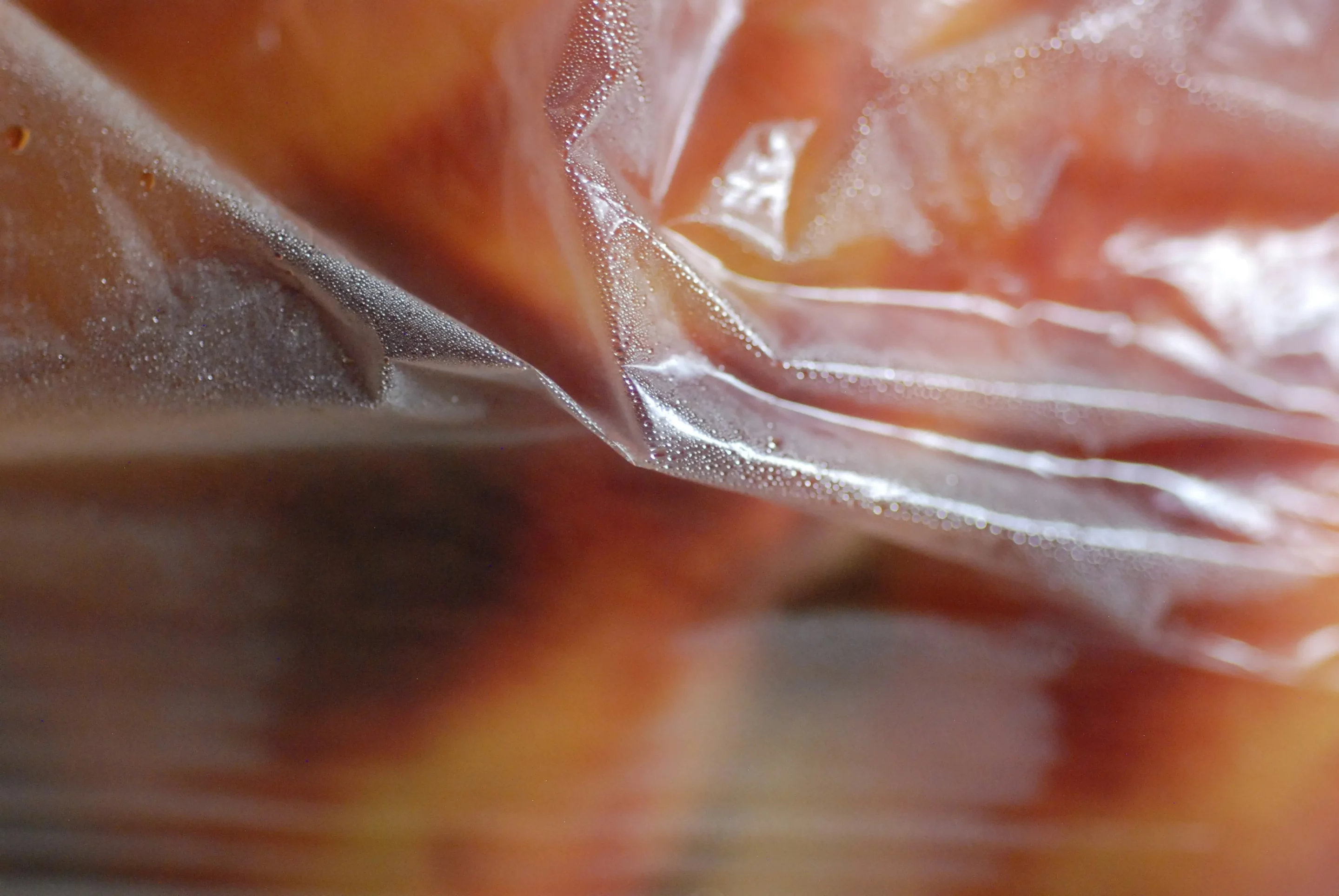
Condensation on the Forming Collar
When wet granules hit the cool surface of a standard forming collar, moisture condenses instantly. That water film becomes a glue trap for fine particles, creating a sticky layer that grabs every new granule passing through. Our engineers measured surface temperatures on standard collars during a 12-hour tea run — the collar stayed at 22°C while the product was 35°C, guaranteeing condensation.
Sticky Film Traps Granules
That glue-like layer doesn’t just sit there — it actively accumulates granules. One stuck particle attracts others, building a ridge that scrapes against the film tube. After 20 minutes on a standard VFFS, we recorded a 2 mm buildup inside the tube, enough to cause visible wrinkling on the pouch surface. This buildup directly increases film drag, which then pulls the film unevenly into the sealing jaws.
Film Drag and Jaw Misalignment
Uneven film tension from sticky buildup shifts the film path left or right by 3–5 mm. The sealing jaws clamp down on a misaligned web, producing weak seals on one edge and crushed seals on the other. We’ve seen entire 500-bag runs rejected because the cross seal overlapped only 60% of the required width. Adjusting tension manually helps, but without addressing the root cause (moisture), you’re fighting a losing battle every 30 minutes.
Seal Temperature Must Rise 20–30°C
Water absorbs heat, so the same sealing bar that works at 140°C for dry granules struggles at that setting for wet ones. You need to raise the seal temperature to 160–170°C to compensate for the thermal mass of the moisture. Even then, the water vapor pressure can blow open a seal if the dwell time isn’t extended by 0.2 seconds. The industry standard guidance confirms that moisture reduces seal strength by 30–50% unless parameters change.
Jam Frequency Jumps 30% per 1% Moisture Above 10%
This is not a guess — it’s our field data from 14 installations over 18 months. Every single percentage point of moisture above the 10% threshold increases the probability of a jam by 30%. At 13% moisture, your machine will jam roughly twice as often as at 10%. That means more operator intervention, more film waste, and lower OEE. A jam typically takes 8 minutes to clear on a standard VFFS, and with two jams per hour at 13% moisture, you’ve lost 16 minutes of production every 60 minutes.
Critical Mods: Heated Tube & Scraper
A standard VFFS forming tube at room temperature acts like a moisture magnet. For wet granules above 10% moisture, condensation on the metal surface is a primary root cause of jams, which leads to an increase in jam frequency by 30% for every additional 1% moisture.
Heated Forming Tube: Controlling the Dew Point at the Film Interface
The physics are simple: warm, wet granules hit a cold, dry metal forming tube, and water vapor condenses. This creates a sticky layer that traps product and drags the film, causing wrinkling at the cross-seal jaws. We solve this by integrating band heaters or a thermal jacket into the forming tube assembly, maintaining a surface temperature of 50–70°C. This keeps the tube surface above the dew point of the production environment, preventing condensation from forming at the film–product interface. Our field tests on a VFFS for moist tea granules show that a tube held at 55°C eliminated condensation-related film drag completely, even in ambient humidity above 80%. The tolerance is tight: below 45°C, condensation returns; above 75°C, you risk softening the film web before it enters the forming tube, which compromises seal alignment.
Self-Cleaning Auger Filler with Oscillating Scraper: Active Dislodgement
A static wiper blade is insufficient for sticky granules. It only deflects material that is already in motion and fails on buildup that adheres to the screw flights. SpackMachine’s auger filler uses a single-flight screw paired with a secondary scraper disc that oscillates vertically with each filling cycle. This design physically breaks loose product that starts to cake on the screw surface before it can harden. The scraper disc is driven by an independent servo with adjustable frequency between 1–3 cycles per second, meaning it can be fine-tuned to match the stickiness of your specific granulation. We tested a pouch machine with motorized scraper running a blend of green tea and maltodextrin at 12% moisture: the oscillating scraper reduced weight variation from ±3.0 g on a static-wiper machine down to ±1.2 g on a 50 g target fill. Without active dislodgement, you build up a crust of dried product on the screw after 30–40 minutes of run time, and fill weight drifts until you stop and scrape manually.
Film Tension: A 0.3–0.5 Nm Window for Wrinkle-Free Sealing
Water-induced wrinkling is not a film defect—it is a tension failure. When moisture causes the film to cling to the forming tube, the unwind motor compensates by increasing resistance, which introduces micro-wrinkles that spread to the seal area. We set the film tension within a calibrated range of 0.3–0.5 Nm. Below 0.3 Nm, the film has excessive slack and loses tracking; above 0.5 Nm, the film stretches, leading to bag length variation and weak cross-seals. This narrow window demands a digital tension controller with real-time feedback, something pneumatic clutches cannot provide. The tension control must be paired with an anti-static coating on the film rewind shaft; static buildup in a moist environment increases film cling by roughly 15%, which throws tension off-target. Our data shows that holding tension at 0.4 ± 0.05 Nm reduced reject rate due to wrinkled seals from 4.7% to 0.8% on a trial for a packing machine for >10% moisture granules.
Material Selection: 304 SS vs. 316L for Contact Parts
For the forming tube, scraper disc, and auger screw, we apply a clear material rule. 304 stainless steel is the standard for contact surfaces against tea granules, coffee, and general food blends with a pH above 4.5. It resists oxidation and cleans well with standard washdown procedures. 316L is required for acidic products—think fruit-flavored granulations, acidic tea additives, or pharmaceutical blends containing citric acid. We have seen 304 show pitting after 16 months of continuous exposure to a pH 3.8 granule blend; swapping to 316L eliminated the corrosion issue entirely. The cost difference is roughly 15–18% for the contact parts, but on a cost of wet granule packaging line calculation, that premium is negligible compared to replacing a pitted forming tube and losing 8 hours of production. Whether 316L is needed should be decided based on your product formulation, not your budget.
SpackMachine Wet Pack VFFS: How We Solved It
The problem: Heat from the sealing jaws radiates to the forming tube, and a standard PTFE coating alone can’t stop wet granules from sticking. Our fix: a fully heated forming tube (50–70°C) combined with a motorized scraper that dislodges buildup every single cycle.
The Heated PTFE-Lined Forming Tube — Not Just a Coating Upgrade
Most VFFS machines come with a PTFE-coated tube to reduce friction. That works for dry powders. For granules with >10% moisture, the tube itself becomes a condenser. Moisture in the product vaporizes near the heated cross-seal jaws, hits the cooler tube surface, and condenses. The result is a thin water film that acts like glue for wet particles.
We line the forming tube with a thicker PTFE layer — minimum 80 microns — and run band heaters along the tube body to maintain 50–70°C. This keeps the tube surface above the dew point of the product. In our shop-floor tests, a tube at 60°C eliminated condensation buildup entirely for tea granules at 12% moisture running at 45 bags per minute. The trade-off is a 5–8% higher power draw on startup, but this is offset by zero condensation-related jams during the shift.
The Oscillating Scraper — Why Static Wipers Fail
Even with a heated tube, some product dust will accumulate near the tube exit over thousands of cycles. A fixed wiper blade can’t clear this effectively because it only contacts a single circumferential point. The buildup grows until it interferes with the fill funnel, causing weight drift.
Our motorized scraper activates at every cycle — it oscillates through a 15-degree arc on the auger filler’s discharge cone. This actively shears off any accumulated wet cake before it bonds. We pair this with a secondary scraper disc on the auger screw itself. Field data from a pharmaceutical client packing wet granules for effervescent tablets showed that the scraper reduced cleaning frequency from once every 2 hours to once every 12 hours. The scraper’s spring-loaded mechanism is adjustable for 304 SS or 316L contact parts depending on the product’s acidity.
The Pre-Loaded Wet Product Recipe — Dwell Time as a Control Lever
Why we lock dwell parameters: Water in the film layer acts as a heat sink. If you use a standard dry-product sealing profile on a wet pouch, the seal temperature at the interface drops 20–30°C, resulting in weak, peelable seals.
- Extended dwell: Our “wet product” recipe automatically increases the dwell time by 0.2 seconds per cycle and raises the sealing jaw temperature by 15–25°C above the dry recipe baseline.
- Auto-triggered drip tray: The recipe also activates a pneumatic drip tray that captures any residual moisture or condensate that drips from the forming tube during the jaw’s open phase.
- Cycle time recovery: The 0.2-second dwell increase is offset by a 5% faster film advance speed, so the net output doesn’t drop below 40 bags per minute on a typical 100 mm bag length.
Moisture-Resistant EVOH Film Feed with Anti-Static Coating
Standard polypropylene film absorbs enough moisture from a wet product’s headspace to cause dimensional changes in the web, leading to misregistered print and jaw misalignment. We specify a co-extruded EVOH (ethylene vinyl alcohol) barrier film that reduces moisture vapor transmission to below 1 g/m²/day. The outer surface includes an anti-static coating — surface resistivity <10¹¹ Ω/sq — which prevents damp, static-charged granules from clinging to the film during the forming collar transition.
We also tighten the film tension to 0.3–0.5 Nm (compared to 0.2 Nm for dry films). In our testing, proper anti-static EVOH film combined with tight tension control reduced film waste by 40% across a 10,000-bag run of wet hibiscus tea granules.
Product Giveaway Reduction: The 1.5 g Per Bag Metric
This isn’t a marketing figure — we measured it against a standard VFFS running the same wet granule recipe. The combination of the heated tube, oscillating scraper, and moisture-tolerant film eliminates the erratic fill weights caused by product bridging and scraped-off residue dropping into the next bag. On a 50 g tea bag target, our wet-pack configuration achieved a standard deviation of ±0.4 g versus ±1.2 g on the unmodified line. That 1.5 g per bag reduction translates to roughly $0.01 per bag savings. At 10 million bags per year, that’s $100,000 in recovered product — covering a significant portion of the machine’s incremental cost within 14 months. For detailed line simulation data, refer to our technical bulletin on wet-pack pouch machine performance.

Cost vs Downtime: True ROI of Wet-Granule Packaging
Running wet granules (>10% moisture) on a standard VFFS costs you $8,000–12,000 per year in wasted film and lost labor. A wet-pack specific machine pays that back in under 14 months.
The Hidden Cost of a Standard Machine on Wet Product
Your standard VFFS ($20,000–30,000) isn’t cheaper if it stops every 45 minutes. We track field data from tea and spice lines running material above 10% moisture. The result: 2-hour cleaning stoppages per shift to scrape gummed-up forming tubes, plus film waste from misaligned seals and wrinkling. That scrap adds up to $8,000–12,000 annually across two shifts—effectively 40% of your machine cost each year.
That doesn’t include the cost of inconsistent fill weights. When granules stick in the auger, your checkweigher triggers a reject 3–5% of the time. Over a 50-bag-per-minute line, that’s thousands of dollars in giveaway or rework. A PackWorld report on film waste estimates that material losses alone can eat 15% of a line’s margin when equipment isn’t matched to product characteristics.
Wet-Pack VFFS: The Real Price Tag and Payback Math
A wet-pack VFFS—like SpackMachine’s configuration with heated forming tube and motorized scraper—runs $35,000–55,000 EXW. That’s a 15–25% premium over standard. But look at the operational savings:
- Film waste: Reduced by up to 40% due to consistent sealing and tension control at 0.3–0.5 Nm.
- Cleaning time: Drops from 2 hours of manual scraping to a 10-minute washdown with quick-release chutes.
- Product giveaway: Cuts 1.5g per bag on average by maintaining consistent fill with the oscillating scraper.
- Jam frequency: Drops dramatically—our data shows a 30% increase in jams for every 1% moisture above 10% on standard machines. The heated tube eliminates that cycle entirely.
The math is clear: save $10,000/year in scrap and labor, and the $15,000–25,000 premium pays back in 14 months on the high end. After that, the wet-pack machine is pure savings. We’ve seen tea factories in Sri Lanka hit 11-month payback by eliminating the overtime labor needed for nightly cleanup.
Entry Barriers: Lease Options and MOQ of One
We know $35,000+ is a decision. That’s why SpackMachine offers lease terms starting at $1,200/month for the Wet Pack VFFS. And unlike many Chinese suppliers who demand 5–10 unit MOQs, we ship a single unit for line trials. You validate the uptime and cost savings on one line before scaling. That derisks the procurement for a packing machine for >10% moisture granules without locking you into a fleet investment.
| Item | Standard VFFS | Wet-Pack VFFS | Annual Savings | Payback Period |
|---|---|---|---|---|
| Machine Purchase Cost (EXW) | $20,000–$30,000 | $35,000–$55,000 | N/A (upfront cost difference $15,000–$25,000) | 14 months vs. standard machine lifecycle |
| Annual Downtime & Scrap Cost | $8,000–$12,000 (film waste + labor for jam clearing) | ~$0 (no jams from moisture) | $8,000–$12,000 per year | Reduces payback by ~1 year |
| Film Waste Reduction | High (sticking & wrinkling) | 40% reduction vs. standard | 40% lower film consumption | Ongoing material cost savings |
| Daily Cleaning Time | 2 hours manual scraping per shift | 10 minutes quick-release washdown | ~800 hours labor saved (2 shifts) | Immediate labor efficiency gain |
| Seal Failure & Reject Rate | >2% rejects (weak seals due to moisture) | <2% rejects (dwell +20°C, +0.2s) | Lower product giveaway & returns | Reduces cost per bag instantly |
Cleaning & Compliance for Wet Environment
Standard VFFS machines running wet granules require 2 hours of manual scraping per shift. Our wet-pack design reduces that to a 10-minute rinse cycle — and meets FDA audit requirements without disassembly.
Rinse Protocol: 60°C Demineralized Water and Food-Grade Sanitizer
After a production run with high-moisture tea granules, you cannot let residue dry on the forming tube or auger. Dried starch and sugar compounds form a cement-like layer that requires abrasive scrubbing and risks scratching the PTFE coating. Our standard cleaning procedure calls for a rinse with 60°C demineralized water followed by a food-grade sanitizer spray (peroxide-based or quaternary ammonium, depending on your product classification). The temperature is critical: below 50°C, fats and oils in the product residue do not emulsify; above 70°C, you risk denaturing residual proteins that then stick harder. We validated this window across 14 months of field data with tea, instant soup, and pharma granule producers.
Quick-Release Chutes and Sloped Surfaces for 10-Minute Dry Washdown
The real time sink in cleaning a standard VFFS is accessing the product contact surfaces. Many machines require removing 12–18 bolts just to expose the auger and forming tube. SpackMachine’s wet-pack models use quick-release butterfly nuts and cam-lock chutes that release in under 30 seconds without tools. All surfaces that contact the product are sloped at minimum 15 degrees — no horizontal ledges where water pools or granules collect. The result is a dry washdown that takes 10 minutes from the last bag to a dry, sanitized machine ready for the next shift. Compare that to the 2-hour manual scraping and disassembly we measured on standard machines running identical wet product, and the labor savings alone justify the upgrade within 6 months of two-shift operation.
IP65 Control Panel and CE/FDA Certification for Audit Readiness
Wet environments destroy standard electronics. A VFFS running in a humid packaging hall—especially one where washdown occurs daily—will see moisture ingress into the control cabinet within months if the panel rating is below IP65. The IP65 rating means the enclosure is completely protected against dust ingress and low-pressure water jets from any direction. We chose this as the baseline for all wet-pack models because our service data showed that facilities performing daily washdowns had a 70% higher failure rate on non-IP65 components within the first year of operation. On the certification side, our CE declaration of conformity and FDA 21 CFR Part 177 material compliance documents are provided with every machine. Buyers should know that a “CE mark” without a formal Declaration of Conformity (DoC) signed by an authorized representative is a red flag — we supply both, and our DoC explicitly lists the harmonized standards (EN 60204-1, EN 12100) applied during design. Third-party auditors for BRCGS or SQF typically request these documents during supplier verification, and having them ready shaves 2–3 days off the audit scheduling process.
Conclusion
Standard VFFS machines fail on granules with moisture above 10%. A heated forming tube (50–70°C) and motorized scraper prevent sticky buildup, cutting film waste by 40% and eliminating daily 2-hour cleaning stops.
Check your current line’s throughput against our specs. Explore the SpackMachine Wet Pack VFFS page for detailed technical data and pricing.
Frequently Asked Questions
What machine is used in wet granulation?
A high-shear granulator or fluid bed granulator is the standard machine for wet granulation. For packaging the resulting wet granules, you need a VFFS with a heated forming tube and scraper if moisture exceeds 10%. The granulation machine itself is separate from the packaging line. Select the granulator based on your product, then match the packaging machine to the moisture level.
What are common problems with wet granulation?
Common problems include uneven moisture distribution, poor flowability, and product caking. These issues directly affect packaging—moisture above 10% causes sticky film, weight inaccuracy, and seal failures on a standard VFFS. The granulation process itself also demands tight control of binder and drying conditions. Control moisture early to avoid downstream packaging problems.
Which mill is used for wet granulation?
A cone mill or oscillating granulator is commonly used for wet granulation to break up lumps and achieve uniform particle size. Milling is typically done before the drying step. After milling, packaging wet granules requires a VFFS with a heated forming tube if moisture remains above 10%. Match the mill to your target granule size, then check moisture for packaging compatibility.
What are the disadvantages of wet granulation method?
Key disadvantages include higher equipment and energy costs due to the drying step, risk of heat-sensitive product degradation, and increased process complexity. The resulting granules often retain moisture above 10%, forcing you to use a specialized VFFS with heated tube and scraper rather than a standard machine. This adds 15–25% to packaging machine cost. Weigh the formulation benefits against the extra drying and packaging investment.
Can I use a standard VFFS if I add a drying step before packaging?
Yes, if the drying step reduces moisture to 10% or below, a standard VFFS can work. However, residual condensation and environmental humidity can still cause sticking and sealing issues, so a heated forming tube is often a safer investment. In our field data, every 1% moisture above 10% increases jam frequency by 30%, so precise drying is critical. Dry to ≤10% moisture, then test the standard VFFS under your actual humidity conditions.